




Ready to drive incremental growth with influencers?
If ditching the randomness of influencer campaigns and building a predictable, ROI-first influencer program sounds like a plan. Consider talking to our team!


Performance Tracking
Discover 5 places where influencer marketing drives revenue or cuts costs, but usually gets ignored.


Contents
When you ask for more budget for influencer marketing, the conversation comes down to this question from your CMO or CFO: “How much revenue did influencer marketing drive?”
So you pull up what you can track. Sales from links, codes, and affiliates. It’s good revenue, but not as massive as ads.
What you hear next is some version of:
“This looks fine, but ads still drive more revenue. We don’t fully know the impact here, so it’s hard to justify giving influencer marketing a bigger chunk of the budget.”
The problem is that revenue is only the part that gets attention.
The better question is: “What impact is influencer marketing creating across the business. And where is that impact being counted?”
Because influencer impact doesn’t live in exact revenue numbers.
It shows up across five different parts of the business. But those don’t show up under “influencer revenue” in a dashboard. They get credited to other channels. That’s why influencer programs often look weaker on paper than they actually are.
Once you can answer your CFO and CMO with numbers & evidence, even if they’re directional or conservative, the comparison with ads becomes fairer. And that’s when influencer marketing stops sounding like a side channel and starts looking like a system that lifts everything else.
Here’s where to look, and how to quantify what you find 👇
What do you do when you hear about a new brand? You go and check out the website. But you're still skeptical at this point, so you go and check their social media accounts on TikTok, Instagram, or YouTube.
If nothing shows up, or if it’s just scattered brand posts, it feels like that brand exists, but no one really (even the brand founder!) cares about it. There’s nothing that helps it stand out from the alternatives. With so many options competing for attention, that’s usually enough for you to move on.
One way to solve it without influencer marketing is to fill up social media with customers’ organic posts.
But relying on organic customer content to fill that space is slow. It can take months or years before customers post consistently enough for the brand to be visible in social media search results.
Brand content alone doesn't fill this gap. It tells you what the product is supposed to be, not how people actually use it.
Influencer content changes what people see when they search for a brand. Instead of just brand posts, they see real people using the product in different situations.
For example, when I searched for Loop Earplugs on TikTok, it showed me so many people using them.
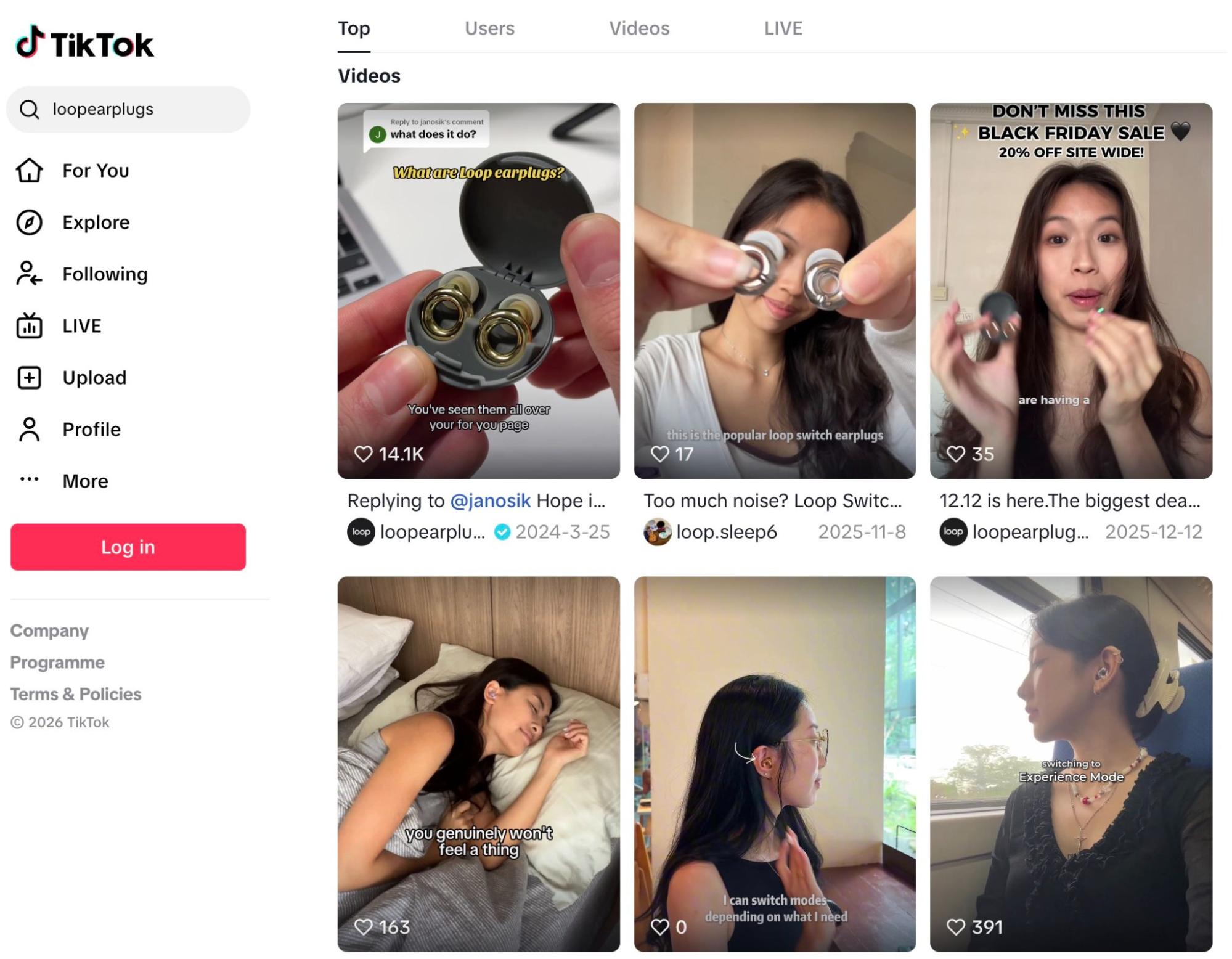
It helps people figure out whether this product is for them or not. So when they later see an ad, open an email, or visit the website on their own, they’re more likely to buy without any delays.
Let's say a brand works with 20 creators over a month. Each post gets around 12,000 views on average. That’s roughly 240,000 total views.
Not everyone takes action. But even if just 2% of those viewers later search for the brand on TikTok, Instagram, or Google, that’s 4,800 branded searches.
From there:
- About 35% of those searches turn into website visits → 1,680 visits
- With a 2.5% site conversion rate, that’s 42 orders
- At a $60 AOV, that’s roughly $2,520 in revenue
Note: These are conservative estimates. Even at half these rates, the impact is still meaningful and still largely invisible in influencer reporting.
That revenue usually shows up as direct, organic, or search. It doesn’t show up under influencer reporting. But the reason those people searched in the first place was because they saw the product earlier through creators.
Influencers create all types of content as part of their collaboration. There are product demos, lifestyle photos, how-to-use videos, etc. Influencer content gets reused beyond the original influencer post. It gets used in ads, added to product pages, included in emails, or shared on brand social media accounts.
This reuse replaces work that would normally require agencies or in-house production. Instead of writing new briefs and scheduling shoots, teams already have material they can work with. Creative production becomes faster and less dependent on highly planned campaigns.
But that impact is not shown anywhere. Worse, the impact of cost savings goes to other departments.
When you partner with influencers, the expense is clearly labeled as influencer marketing expense. But when you calculate ROI, it's only calculated on the affiliate sales you get.
The money you spend to work with influencers, including the rights to use their content, is always logged under influencer marketing. But when the paid ads team doesn’t need to request new creatives from an agency because influencer content is already available, that saving gets counted under paid media.
Say you spend $30,000 on influencer collaborations in a quarter. That full amount shows up under influencer marketing.
But because you now have creator content:
- The ads team skips a $12,000 agency shoot
- The website team avoids an $8,000 product shoot
- The email team reuses creator assets instead of hiring a designer, saving $5,000
Those $25,000 in savings show up under other teams, not influencer marketing.
When ROI is reviewed, influencer marketing still looks like a $30,000 cost judged only on sales. A more accurate view is:
Influencer ROI = (Sales + $25,000 saved) ÷ $30,000 spend
There’s also a timing advantage. Agencies work in batches. Influencer content comes in continuously. Different styles, different people, different formats, without restarting the process each time.
When brands want to test a new idea, they turn to surveys, focus groups, or paid test campaigns. These methods are expensive and take weeks to run.
But influencer collaborations can do some of this testing at a fraction of the cost, and in less time.
Say your brand sells earplugs. You send it to a group of creators, each with a different type of audience. One creator frames it as something that helps them sleep in noisy environments. Another mentions that it helps them focus because they have ADHD.
Let's imagine that the ADHD-focused post gets a large number of comments, saves, and follow-up questions, which is not very unlikely. That response tells you that ADHD folks are a big target audience for your brand.
It's possible that the post didn't drive as many sales. But it did help you discover a use case and an audience you hadn’t prioritized before. That insight can be used to create ads targeted at the ADHD audience. It might open up more collaborations.
Now put numbers to it.
If running a small research study costs $5,000–$10,000, and seeding 10 creators costs $1,000, you’ve learned something real at a fraction of the cost. But the savings don't get logged as “influencer impact.”
If you want your product to be stocked in retail stores like Walmart or Ulta Beauty, the first thing they'll look at is your sales data. They don’t want products sitting on shelves that don’t move. But sales numbers aren’t the only thing they look at.
They also look for signs that a brand is creating demand outside the store. Retailers want to know people are already aware of the product and looking for it,so the job of driving demand doesn’t fall only on the store.
This is where influencer marketing plays a role.
It shows that the brand is putting effort into creating awareness. If people see the product on social media, hear others talk about it, and recognize it before they ever see it in a store, the retailer will be convinced that the product will sell.
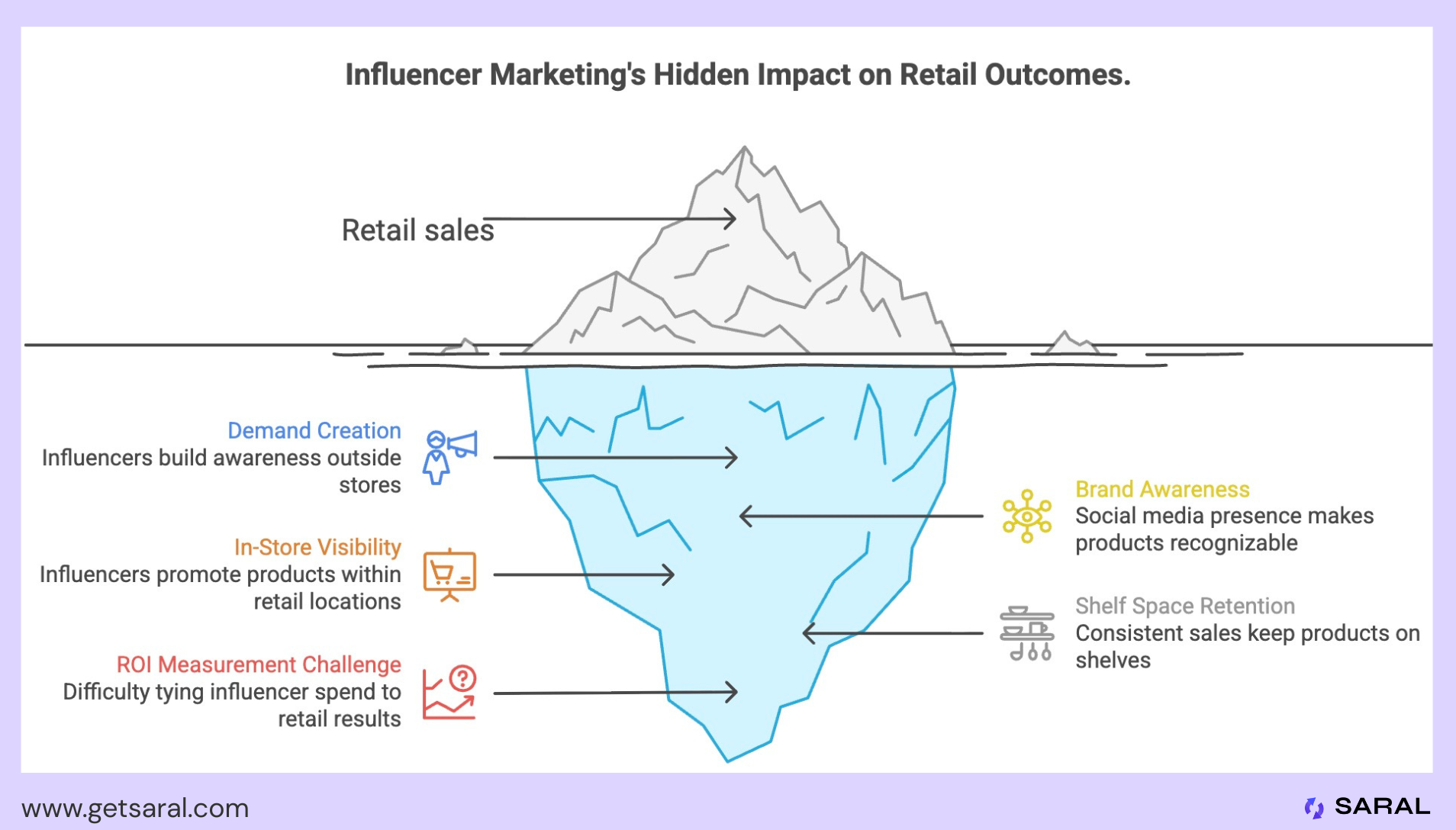
Once the product is on shelves, influencers still matter. When they show the product in real stores or talk about where to find it, more people notice it and buy it. Products that sell consistently stay on shelves. That also helps a brand keep its shelf space instead of getting replaced during the next reset.
Brands like Olipop collaborate with influencers to consistently drive people to their shelves in Target and Walmart.
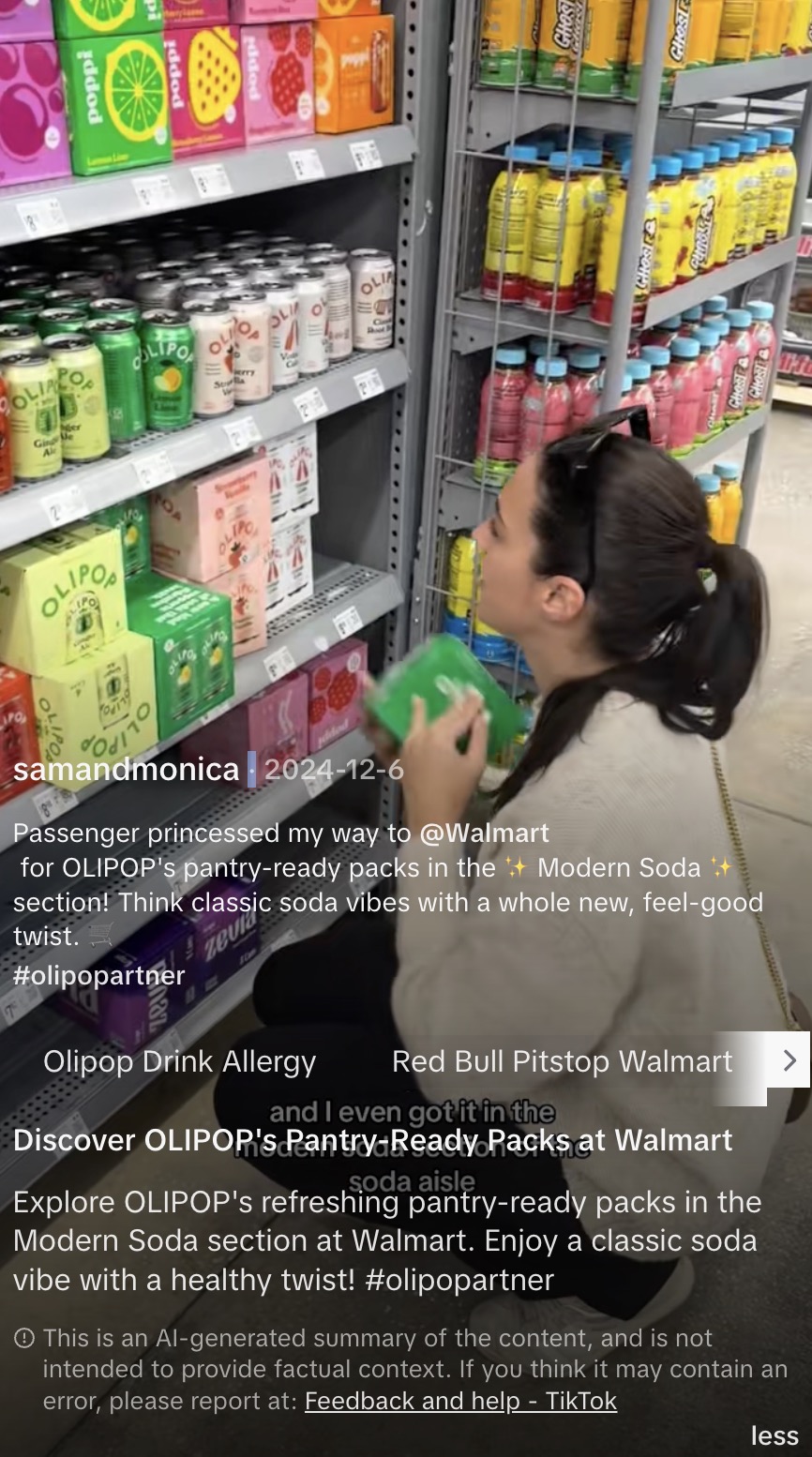
The problem is how this gets counted.
Influencer spend shows up clearly as a cost. But the result looks like “retail is doing well.” There’s no easy way to tie those in-store outcomes back to influencer work, so the impact gets missed when ROI is reviewed.
One less obvious reason influencer impact gets underreported is cookie consent.
On many Shopify stores (especially in the EU), analytics and affiliate tracking don't fire until a visitor accepts cookies.When someone clicks an influencer link but doesn't consent, the visit and even the conversion can lose attribution in tools like Google Analytics or affiliate dashboards.
The sale still happens, but it often shows up as "direct" or disappears from influencer reports entirely.
This is why influencer traffic can look weaker than it actually is.
Tools like Consentmo help by improving consent rates and making sure analytics platforms receive the right signals once users opt in, reducing how much legitimate influencer-driven activity gets lost in reporting.
Everyone these days has ad fatigue. If anything looks too polished, too salesy, people scroll past it. Even if the offer is great or the product is useful.
But if you use influencer content in ads, it clears that first hurdle of getting attention because it doesn't feel like an ad. It looks like regular feed content. That hooks people.
We hosted an insightful webinar with the team at Charlie Oscar. Dan Wilson, who’s worked with 30+ DTC brands on measurement, shared a pattern he sees over and over again:
When you only measure the direct impact (clicks and codes) you’re measuring about 20% of the total value of the channel. For every £1 you see tracked in analytics, there’s probably another £4 happening quietly behind the scenes, often attributed to other channels.
👉 If you want to avoid the trap of under-reporting your own work watch the full webinar. See successful teams are accounting for the impact of influencer marketing that shows up later.
Once audiences’ attention is there, the message lands better.
Seeing a real person use a product reduces skepticism. People trust it more than brand-made creative. The result is that ads convert better. CAC comes down because the same budget brings in more customers.
Charlie Oscar team sees this kind of uplift show up in the metrics CFOs actually care about:
Let's do the math even if your ad improves by 1.5% (which is very conservative number).
Let's say you spend $25,000/month on paid ads, and your ads convert at 1.2%. With influencer-style creative, conversion improves to 1.5%
That’s a 0.3% lift, which sounds small but isn’t.
If those ads drive 50,000 clicks a month:
- At 1.2% → 600 orders
- At 1.5% → 750 orders
That’s 150 extra orders without increasing spend.
At a $70 AOV, that’s $10,500 more revenue from the same budget.
But here’s the blind spot.
The lower CAC shows up under paid media. The savings get credited to better ad performance. The influencer program still carries the cost of producing that content.
SARAL helps you turn influencer posts into paid ads without manual follow-ups or messy approvals. When a creator posts about your brand, SARAL detects it automatically and lets you request usage rights in one place.
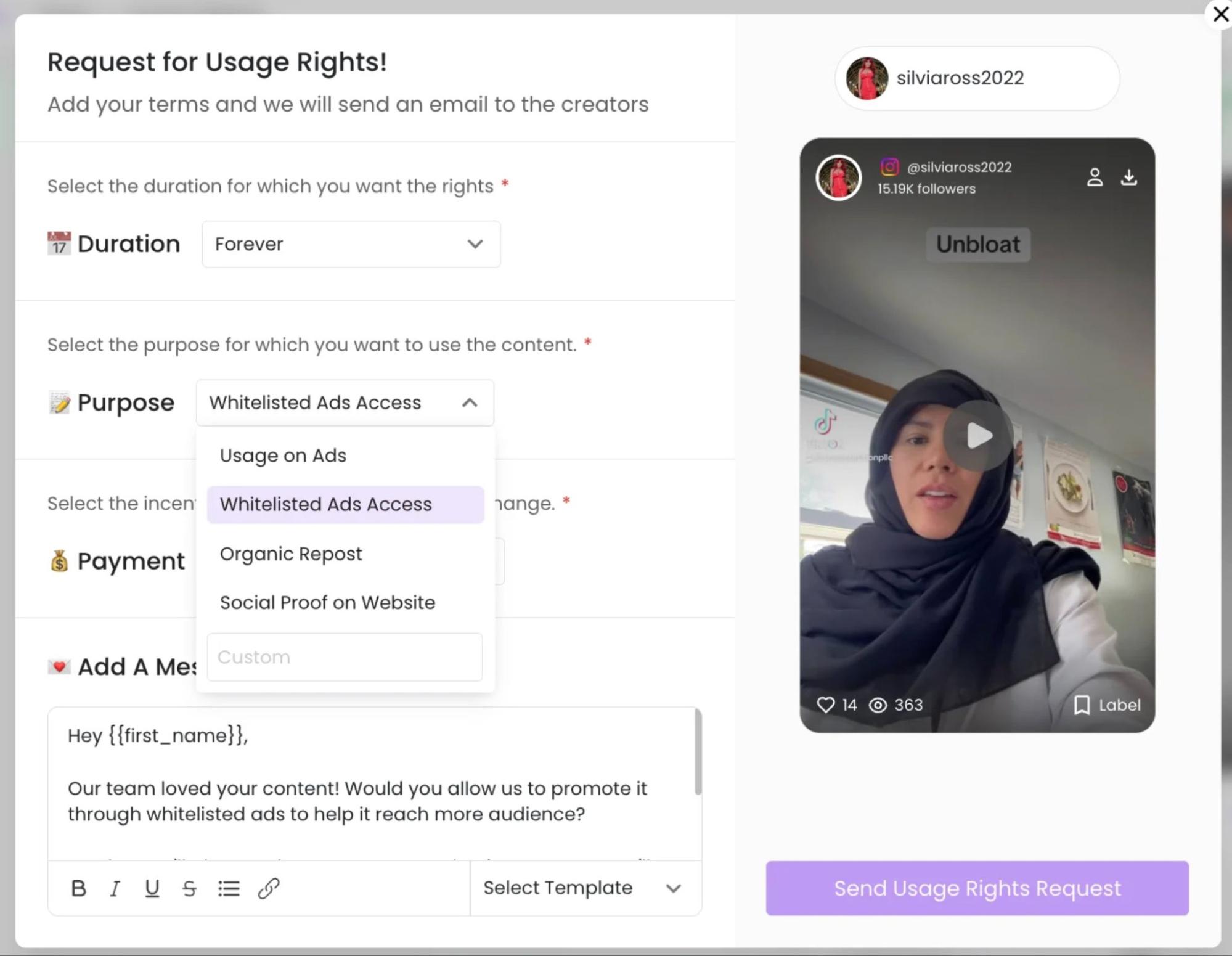
Once approved, your paid team can then run ads directly from the creator’s handle.
Every influencer marketing manager knows that their work has impact but their reporting can't prove it. We wrote a guide to help you close the gap.
Inside the guide, you’ll learn how to:
At some point, the bottleneck stops being ideas.
You already know influencer marketing can drive discovery, better ads, stronger retail outcomes, and faster learning. The real question becomes: can you run it in a way where all of that impact is actually visible and usable?
That’s hard to do when everything lives in spreadsheets, inboxes, and scattered folders. You end up spending your time tracking posts, chasing approvals, and pulling reports instead of doing the work that creates impact in the first place.
SARAL exists to take that operational weight off your plate.
It helps you find the right creators, manage relationships, organize content, handle usage rights, and track performance in one place. So you can spend more time on strategy and less time proving that the work matters.
👉 Book a 30-minute consultative demo and see how it can help your brand.
Sign up for a 7-day email course on the unique "Predictable Influence" strategy used by top brands like Grüns, Obvi, Tabs Chocolate.

If ditching the randomness of influencer campaigns and building a predictable, ROI-first influencer program sounds like a plan. Consider talking to our team!
