




Ready to drive incremental growth with influencers?
If ditching the randomness of influencer campaigns and building a predictable, ROI-first influencer program sounds like a plan. Consider talking to our team!


Performance Tracking
Learn how to identify early signals, track real outcomes, and make better decisions at every stage of influencer marketing.


Contents
There’s a psychological concept known as the streetlight effect. When something is hard to find, people search where it’s easiest to see, not where the answer actually is.
The same thing happens with influencer marketing. When measurement feels messy, teams rely on one most visible number. It can be:
That shortcut doesn’t just affect reporting. It affects decisions that lead to cutting creators too early, scaling the wrong ones, and ultimately missing real opportunities to grow revenue.
.jpg)
In this post, we’ll break down why relying on a single metric leads to bad decisions, how to separate early signals from real outcomes, and what it looks like to measure influencer marketing in a way that actually supports growth.
It’s easy to default to a single KPI, especially for small teams that need to move fast. One number makes decisions quicker, simplifies reporting, and reduces back-and-forth with stakeholders. When time and resources are limited, focusing on one metric can feel like the most practical option.
The problem starts when that one KPI is treated as the full picture instead of a partial signal, and decisions get made without accounting for the stages and behaviors that lead to it.
Revenue is the outcome everyone ultimately cares about, but it’s also the last thing to show up. When it becomes the primary way creators are evaluated, the program quietly shifts toward short-term judgment.
What goes wrong:
On the other end of the spectrum, some teams lean heavily on views, comments, or likes because they’re immediate and easy to see. These numbers feel active. They move fast. They give a sense that something is happening.
But they’re not indicators of true influence.
What goes wrong:
One way to tell if you're over-focused on one KPI is to look at how decisions actually get made day to day. You might notice patterns like these:
If more than one of these feels familiar, it usually means the program lacks a clear measurement structure.
The easiest way to get clarity in influencer reporting is to separate the metrics that show early signals from the metrics that show outcomes.
Kelsey, Chief Commercial Officer at Slumberkins, shared how they structure their influencer metrics in practice:
"We break up our KPIs into two different types of KPI. The first is all about the outreach. We’re tracking how many people we’re reaching out to, how much response we’re getting to that, how many we’re gifting, and then how many are posting. We’re also watching post per influencer as a secondary KPI… We want them actually building a relationship with the brand.
And then the second group of KPIs is more of your traditional growth marketing KPIs. We’re looking at CAC. We’re also looking at CPC and CPMs for influencers specifically, and comparing that to some benchmarks."
Leading metrics are early signs that something is about to happen. They don’t confirm the outcome, but they do tell you the direction in which things are moving.
For example, if someone starts reading ingredient labels, cooking at home, and walking after dinner, you can guess their health will improve before any weight or blood test shows it.
Influencer marketing works the same way. Before you ever see revenue, ROAS lift, or CAC improvements, there are signals that show whether your influencer marketing strategy will work or not. They help you decide what to keep doing and what to fix without waiting for sales to show up.
Leading metrics aren’t the same for every team. They depend on what you’re trying to achieve at that stage of your program. The key rule is simple: the metrics you track early should clearly lead to the result you care about later (lagging metric).
Follow these 3 steps to make sure that the leading metrics are useful for your program 👇
.jpg)
Before you think about metrics, decide what progress means right now. Not the final business outcome, just what would tell you the program is moving in the right direction.
At each stage of an influencer program, success looks different:
Everyone on the team should be able to answer, “What are we trying to accomplish right now?” If that’s not clear, every metric will feel important, and none will guide decisions.
Once the direction is clear, you look for the earliest visible signs that things are working. These are not goals. They are clues.
For example:
These signals don’t mean you’ve succeeded yet. They tell you whether you’re on the right path.
This distinction matters because it keeps you from judging results too early and helps you decide what to nurture, what to fix, and what to stop.
But… data is scattered across tools.
Once you start tracking the right numbers, the obstacle you'll face is that the data is scattered. You have Shopify for orders, an affiliate tool for codes, social platforms for post performance, ad accounts for whitelisting results, plus a bunch of screenshots and sheets to stitch it together.
SARAL exists to solve this gap by bringing those metrics together in one place.
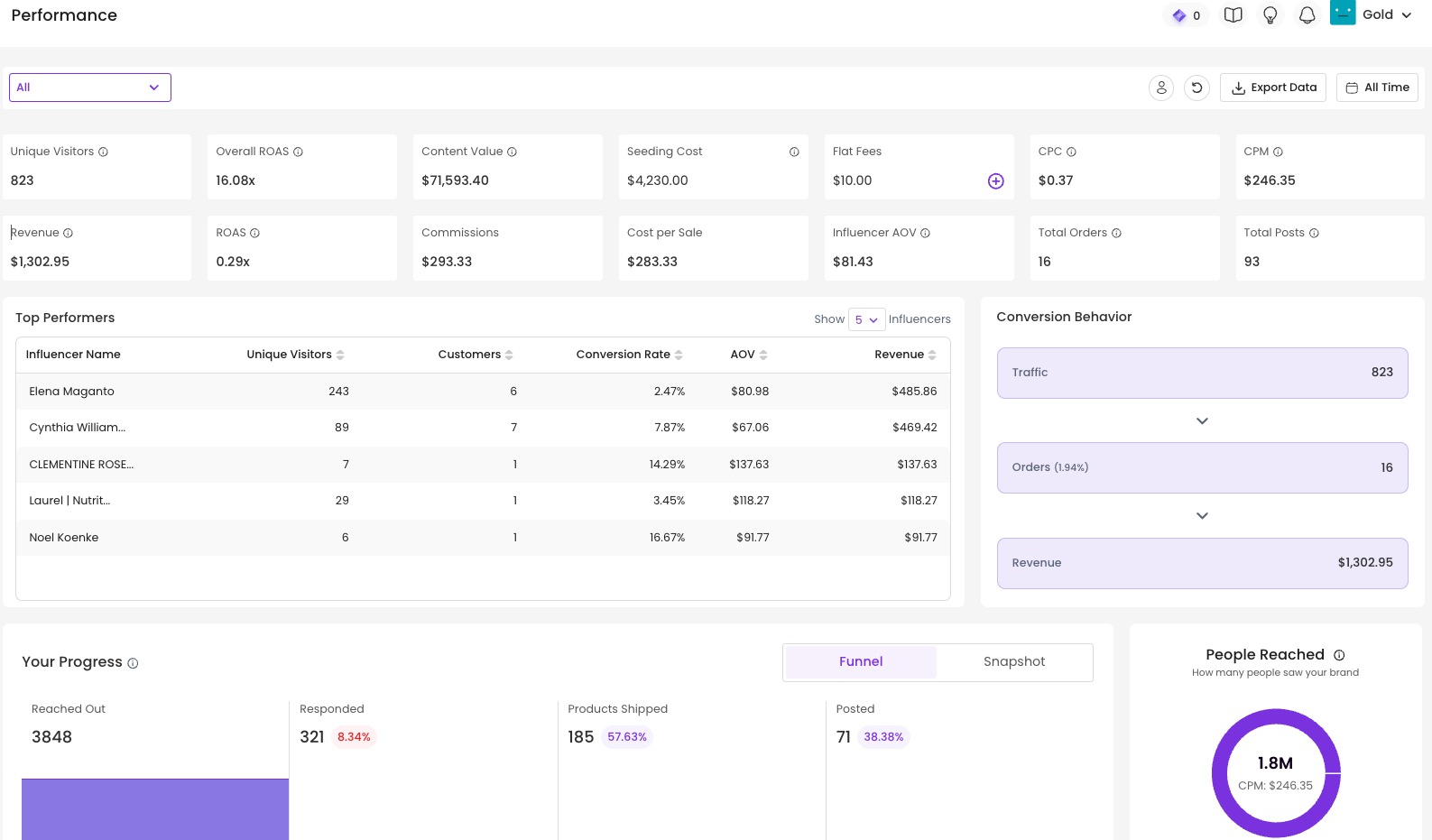
Book a 30-minute consultative demo, and we'll show you how you can track your numbers and connect creator activity to real business outcomes, not just views or codes.
Signals only help if they lead to decisions.
For each metric you track, be clear on:
Lagging metrics are the outcomes you ultimately care about, like revenue, return on ad spend, or lower acquisition costs. They take time to show up because they depend on everything that happens earlier.
For example, in a fitness journey, lagging metrics will be weight changes, more muscles, lower resting heart rate, etc. Those results show up months after the small habits have compounded.
.jpg)
There are 4 things you should know about lagging metrics 👇
Lagging metrics require a wider lens. They make sense when you step back and look at patterns across creators, content, and time. So don't use them to answer “Did this creator work today?” But you can use them to know if your entire system is working or not.
Here are the essential metrics (short, clear, and aligned with what matters):
Lagging metrics only become meaningful after enough creator activity has happened. Looking at them too frequently usually reflects timing, seasonality, or promotion cycles rather than real progress.
.png)
A single slow week might mean fewer posts went live. A strong week might reflect a launch, a sale, or a creator posting at the right moment. To understand what’s actually working, lagging metrics need to be reviewed over a period where multiple creators, posts, and campaigns are included, not just a few days of activity.
Look for patterns over 4–12 weeks, not 48 hours.
Influencer-driven results often look weak or inconsistent when they’re compared to benchmarks that follow completely different rules. For example:
These comparisons create the impression that influencer marketing is underperforming, when in reality the comparisons themselves are flawed.
Instead, use baselines like:
Influencer programs only scale when the results downstream hold up over time. Lagging metrics help you see whether the customers coming in through creators are actually valuable, not just numerous.
When these metrics look healthy, they give you clear signals:
When these signals are missing, it’s usually a sign that something upstream needs attention, not that the entire program should be scrapped.
Influencer marketing becomes expensive when it’s measured poorly. When the only signal you look at is revenue or views, adjustments happen too late, after good creators are already cut or the wrong ones have been scaled.
Clear measurement changes that. When early signals and outcomes are tracked together, you can course-correct while there’s still time.
Once you start thinking this way, the remaining challenge is visibility. Seeing creator activity, content quality, and performance outcomes together is what allows this framework to work in practice. That’s the gap SARAL is built to close.
Here’s what brands using our performance dashboard see in a single view:
If you're tired of piecing together data from five different tools just to answer 'Is this working?', see how SARAL's dashboard gives you the full picture in one view. Book a 30-minute consultative demo.
SARAL isn’t just a reporting dashboard, though. It’s built to run the full program end-to-end, from finding creators and managing gifting to tracking performance and scaling the ones that work.
Sign up for a 7-day email course on the unique "Predictable Influence" strategy used by top brands like Grüns, Obvi, Tabs Chocolate.

If ditching the randomness of influencer campaigns and building a predictable, ROI-first influencer program sounds like a plan. Consider talking to our team!
