


Ready to drive incremental growth with influencers?
If ditching the randomness of influencer campaigns and building a predictable, ROI-first influencer program sounds like a plan. Consider talking to our team!


Meta
DTC brands are shifting from traditional paid ads to lifestyle influencer marketing as consumer trust moves toward relatable creators for driving higher conversions and ROI


Contents
The traditional DTC marketing playbook is developing cracks! The one where you invest in paid social media ads, constantly retarget cart abandoners, create complex performance marketing funnels, etc.
Your average buyer today scrolls past relevant ads without truly registering them, and 70% cart abandoners ghost you for life. Basically, the same retargeting loops are delivering dwindling returns.
In parallel, countless potential customers have shifted trust away from brands and towards people, specifically “influencers”.
This gradual shift is evident because the influencer marketing industry stands at a whopping 19.96 billion dollars globally.
Influencer marketing is quickly becoming a top conversion channel, especially for DTC brands. And, this is not because influencers are louder, but because potential buyers find them relatable and believable.
I am not talking about “product influencers” though - those who post product unboxings, demos, and reviews. While they are relevant to this conversation, I want you to shift attention towards “lifestyle influencers”.
That’s what brands like GymShark and Rhode are doing these days.


They are partnering with lifestyle influencers who don’t spoon-feed products, but embed them in everyday life. These creators layer in context and credibility that ultimately drives conversions.
Because today, brands that shout the loudest don’t convert as much as the brands that show up naturally in people’s lives, maybe as an aspiration or necessity.
Lifestyle influencers are creators who, by the very nature of their social media posts, make a product feel like a natural part of a potential customer’s life – “because they make it a natural part of their own lives.”
That’s what makes them so powerful for DTC brands. You’re not blatantly plugging your product into a content format (unboxing, demo, or any other kind of paid partnership).
A lifestyle influencer organically positions a product into their own life that followers already trust and may wish to emulate.
This is why when they endorse and embed a brand into their lifestyle posts, it hits differently. Their everyday life builds content – what they wear, eat, and more specifically, what they use and maybe recommend.
One Saturday, it’s their weekend morning routine; on Sunday, it’s a workout, sometimes it’s a parenting moment, and other times it’s a home setup video.
For example, consider a lifestyle content creator like “HerHappyFace”. Her posts span everyday moments like getting ready for work, investment and savings routine, travel snippets, skincare regimes, meal prep for the day, and other such day-in-life clips.

Now, while filming these life moments, when she uses certain products – be it coffee, a lip balm, an outfit, a shampoo, it doesn’t feel like a plug. It feels like an organic part of her day to her followers. This is why every recommendation, or just mere usage of a product, carries more weight.
You are not plugging your product directly into an influencer’s content format. You are inserting them into a life that holds credibility.
Remember that:
“Lifestyle Influencers don’t interrupt your feed—they are the feed.”
They don’t just push products, they contextualize them inside their own life. And that’s what modern DTC marketing is missing!
Niche creators go deep on one topic— skincare, tech, finance, gadgets, etc. They try to build authority, which is good, but the downside is that it limits context.
Lifestyle content creators operate across moments, not specific categories. The same lifestyle creator can:
None of this feels forced, because it mimics how people actually live.
For DTC brands, this difference is key.
Instead of a one-off product mention, they get several organic touchpoints across a potential buyer’s day to convert them. With the help of lifestyle influencers, your product doesn’t interrupt content. It simply blends into it.

While lifestyle influencers are capable of delivering high value to brands, not all of them have the same impact. It shifts by follower count:
In practice, high-performing DTC brands don’t pick one lifestyle influencer to position themselves. They often layer across this spectrum to combine reach, trust, and frequency.
And the adoption is steadily increasing! A staggering 86% of American marketers are expected to partner with influencers this year, with lifestyle creators being in the top tier.
Brands turning to lifestyle influencers is not accidental at all! In fact, it is an evolved response to how customers are behaving today. And, unfortunately, traditional marketing is failing to keep up. Why?
There was a time when customers somewhat trusted paid ads, even though they took them with a pinch of salt. They didn’t have much choice before social media anyway to engage with user-generated content, which they now find more credible and relevant.
This is especially true for Gen Z, who had access to social media from a younger age than Gen X and millennials.
Today, all three generations don’t want to be sold to. They want to discover products through people they already trust. This is why traditional ads are causing fatigue and banner blindness.
Data also shows this. 74% of consumers have purchased a product because an influencer recommended it.As things stand today, marketing is less about reach and more about credibility. This is why paid ads interrupt, and lifestyle influencers integrate.
Lifestyle creators collapse the distance between traditional ads and target audiences by placing a product inside a lifestyle that audiences already trust and relate to.
Where most traditional marketing shows products in isolation, lifestyle creators show them in context.
For example, most traditional ads show a skincare product on a white background. Whereas a lifestyle influencer will show it as part of their morning routine inside their real bathroom, daily.
They will integrate your product into their habits and environment so realistically that it’s hard not to feel compelled by them. This makes your audience feel like “I can see myself using this”.

So, what’s changed here? Buyers are not blatantly buying a product. They are buying how that product fits into their life.
This shift is structural, as now platforms themselves support instant buying, offering built-in features like:
This has significantly reduced the gap between discovery and purchase. A potential buyer can observe a product in a lifestyle influencer’s routine, tap on it through direct links placed in the video, and buy quickly. All this without leaving the app.
For DTC brands, content is no longer just influencing decisions; it’s completing transactions.
The proof is in the pudding! DTC marketers are already allocating big-ticket budgets to lifestyle influencer marketing.
Social media influencers were ranked as the No. 1 projected conversion-driving channel for DTC brands in 2025, surpassing social commerce and retail media.
Influencer-led content is letting DTC brands earn an average of $5.20 on every $1 spent on influencer marketing.
Here’s what lifestyle marketing done right looks like in practice:

The #Gymshark66 campaign gave influencers a narrative - that it takes 66 days to build a lasting habit.
Instead of directly pushing their garments for a 66-day workout, GymShark partnered with lifestyle-fitness influencers from all tiers to document their daily lives, meals, mindsets, and workout routines.
As of 2024, this campaign fetched them:
What they pulled off was not just marketing, but habit-based storytelling, that too, at scale.
Takeaway: Lifestyle influencers can turn campaigns into cultural participation loops.

Even before influencer marketing became a thing for DTC brands, Glossier was already treating its customers as lifestyle content creators.
This brand’s popularity jumped not only due to its product-market fit, but also because real customers were encouraged by the brand to share their routines and daily habits on social media (which naturally featured Glossier’s products).
This led to raw, untampered user-generated content, which is high on credibility. No scripting and no forced messaging.
Just Glossier’s products showing up in:
This community-first, creator-led approach helped Glossier turn into a brand that today has a valuation of $1.2 billion.
Takeaway: You don’t need to push marketing when buyers become creators and share how they use your product. Your product starts promoting itself.

Influence doesn't need to be tied solely to views and brand visibility. It can also directly drive measurable business results, as is the case with GhostBed.
This mattress brand discovers and partners with impactful lifestyle and parenting influencers. Basically, creators who naturally talk about sleep routines and home environments. But the real shift is in the model.
This mattress brand discovers and partners with impactful lifestyle and parenting influencers. Basically, creators who naturally talk about sleep routines and home environments.
But the real shift is in the model. Lifestyle creators GhostBed partners with, don’t just post; they also sell. For which they receive 100 USD per sale.
GhostBed’s performance-led influencer model helped build a $50M+ revenue business, proving that lifestyle creators can drive real, trackable sales at scale.
Takeaway: When lifestyle content meets performance incentives, influencer marketing can become a predictable revenue channel.

Outfittery, a personal shopping service for men and women, along with The Cirqle (an AI tool), discovered and partnered with lifestyle influencers whose audiences matched specific style and demographic profiles.
Simply put, they chose “high-relevance” creators over “high-volume” creators whose content already reflected the brand’s target audience. These included working professionals looking for curated fashion delivered conveniently.
How? By ditching a broad search and taking a more focused approach:
Such fine-tuned partnering led to:
Takeaway: When the audience fit is tight, even a handful of lifestyle influencers can outperform broad campaigns.
The pattern is clear. Brands that gain from influencer marketing don’t partner with them to talk about products. They partner with them to embed products into real life, repeatedly, and at scale.
That’s the shift - from isolated, scripted campaigns to building a constant context that naturally embeds brands.
Truth be told, lifestyle influencer marketing works! But not when it’s scattered like a random series of posts, but when it’s structured like a system. For which you need the following framework.

It’s natural for a brand to jump into influencer discovery as a first step. Don’t make that mistake! Always define the outcome first.
What is it you want from a lifestyle influencer marketing campaign?
Do you:
If your goal is all of the above at the same time, don’t expect to accomplish it with a single creator and their posts. Structure it like this:
Distribute different roles to different creators on the influencer spectrum we discussed earlier. Here’s how:
While this is not set in stone, the reason behind this classification is to help you structure your partnerships optimally.
After discovering lifestyle influencers and distributing roles, time the content so there are no overlaps. How?
First, get the mega lifestyle influencers to embed your brand into their everyday lives to generate awareness. Then engage the micro and nano lifestyle influencers to add links to your brand and products into their everyday life videos without directly pushing them.
Know that without a clear objective and content deployment strategy, you’ll pick the wrong creators and measure the wrong things. Simply put,
“The influencer is a lever. Your end goal defines how you pull it”.
Not all lifestyle creators will deliver the same value. Here is how you can match the tier to your goal.
Mega / Celebrity influencers who have a 1Million+ following can offer massive reach. They help you with brand awareness, cultural trends, product launches, etc.)
Smart brands leverage:
Follower count may seem tempting, especially if it is high, but beware that it’s often the weakest signal.
“High follower count does not equal high influence.”
What brands need to study is:
For example, sometimes, you’ll find lifestyle influencer handles who have over a million followers, but their posts merely garner 1200 likes. Prioritize engagement quality over just follower count.
Vetting lifestyle influencers for these attributes ensures that your product reaches the right audience organically. This can ultimately lead to higher brand loyalty and sales conversions.
Therefore, be wary of creators with:
Complying with your brand’s tone and template is important, but this shouldn’t be a hard limit, especially when investing in lifestyle influencer marketing.
If you over-control the way an influencer behaves once you’ve partnered with them, your brand/product may not move the audience.
Therefore, your job is to provide them with a clear brand and product context and its benefits. These work as soft limits.
As for the non-negotiables, ask them to comply with the product claims made by your brand and keep a no-tolerance policy on overselling.
Strictly avoid handing them polished scripts, forced talking points, or any such rigid format.
When you do this, the content they post already feels like it belongs on the creator’s feed.
This is critical. Not all lifestyle influencer content does well on all platforms. So,
Go a step further: Exploring new platforms for influencer marketing: Beyond Instagram and TikTok
Put in place a well-negotiated but fair pay structure. Doing this motivates creators to go a step further for your brand. Here are a few options that work best for DTC brands.
But here’s an expert reality. The more your goal shifts towards sales conversions, the more brand-creator partnerships move away from a one-time-only flat fee.
Move away to what?
This compensation structure is best for conversion-focused campaigns. Because, since you pay influencers a per-sale commission (typically between 5% and 20%, depending on the tier), they naturally optimize content to not just drive engagement but also sales.
Sure, in this case, the flat fee is often less than when it’s only the flat fee you’re paying. But, doing this lowers the upfront cost for your brand while still keeping the influencer motivated to perform well. That is why this compensation structure is ideal for micro and nano-creators.
Partnering with a lifestyle influencer for a single post and video builds preliminary brand awareness. Repetition forges trust with your audience, who are ultimately your customers.
“Lifestyle influencer marketing works best when the same creator embeds the same product across multiple life moments.”
High-performing brands see lifestyle influencers as long-term partners and not campaign vendors. Repeated partnerships with them improve the way they embed content. This automatically compounds audience trust, ultimately boosting sales.
More often than not, lifestyle influencer marketing fails because so many DTC brands use it like traditional advertising. How?
While reach may look impressive on paper, it doesn’t equal results. For instance, a lifestyle influencer may boast 2 million followers. But if those followers are not a good fit for your product, they are not valuable.
On the other hand, a micro lifestyle influencer with 40K engaged followers to whom your product is relevant, will deliver higher conversions.
Simply put, if an influencer’s audience doesn’t match your brand offering, your product won’t resonate, your conversion rate will drop, and your CAC will go up.
I understand sifting through millions of followers sounds overwhelming, but it can be done easily with the help of the following framework.

Know that the goal is to be seen by the right people, not by more people.
Since many DTC brands approach lifestyle influencer marketing traditionally, they end up over-scripting their content. This makes the creator’s content feel like an ad. It digresses from the creator’s usual tone and makes the messaging feel forced.
This disengages the influencer’s audiences. They can detect the inauthenticity almost immediately. Avoid this by gently directing the creator, while still allowing them to integrate the product in a way that best fits their voice.
Partnering with the right lifestyle influencers for sporadic one-off posts does not work. You need repetition to build familiarity and context across time. But several DTC brands often make the mistake of running singular campaigns.
This is why they see limited results and drop this potent medium for sales conversion too quickly. They feel the channel failed, when it was a strategy failure. One odd post appearing across several influencer handles does not build trust.
You need to keep at it for a while before it delivers results.
Many DTC brands deploy lifestyle influencer campaigns without setting up proper tracking. Doing this will not allow you to capture what’s already working.
Take the guesswork out of the equation by tracking every campaign through a mix of systems:
Tracking and analyzing these parameters will tell you exactly what content worked and who created it. Once you identify this, double down on effort.
Even though a wellness creator, a parenting creator, and a home décor creator may all fall under the same umbrella of lifestyle influencing, the people who follow them can be completely different.
This is because even with a seemingly generic approach, most lifestyle creators will focus on one or two aspects of their everyday life, slightly more than others.
If brands don’t recognize this, they risk diluting their brand’s presence with the creator’s audience.
For example: A premium baby skincare brand partners with a home décor lifestyle influencer because they have a large following. Sure, the content looks beautiful, but this is not what the followers go there to find. This leads to low engagement and sales conversions.
Instead, the baby skincare brand discovers and partners with a parenting lifestyle influencer who regularly shares their child’s routine on their handle.
Now, the same baby skincare product appears naturally in bath-time content. This addresses real audience concerns, thus driving higher intent and sales.
Brass tacks, you will always end up underestimating the impact of lifestyle influencer marketing if you can’t tie it to revenue. Tracking performance helps you separate the attention your product gets from actual revenue.
Don’t make the mistake several DTC brands make, which is to focus on product visibility metrics over revenue metrics. Look at both!
Vanity metrics include:
These will tell you how far your content travelled. But, this is only the top layer. Go deeper by gauging revenue metrics. These include:
Know that product/ brand awareness only shows interest. It’s revenue metrics that truly prove impact.
This next step combines numbers with signal-based insights. You must ask and answer the following questions through data.
Finally, move on to the finer qualitative insights.
Remember, in lifestyle influencer marketing, intent first builds in conversation before it shows up in dashboards.
Attributing each sale or conversion back to the specific influencer or post turns influencer marketing into a scalable system.
To do this, track:
Additional Read: What Influencer Metrics to Look for to Find the Best Creators

A handful of DIY Influencer marketing campaigns feel manageable, but the minute you wish to scale, it breaks.
Sure, a handful of creators and Spreadsheets work - maybe 20 or 50 (DIY), but beyond this, you start losing track of:
You start struggling to track links and conversions. Basically, management turns into fragmentation!
Anyway, without attribution, you simply cannot scale influencer marketing, even if it’s working for you.
The right platform doesn’t just organize creators at scale. It also helps DTC brands discover relevant influencers, execute campaigns with them, and track their performance.
In practice, this means that the right platform should help you with:
For example, SARAL goes beyond filters with intent-based discovery through NLP prompts. This helps you find creators the way a human mind would think about them (not just by keywords).
Where certain tools optimize for campaign execution, platforms built for DTC brands like SARAL optimize for profitability.
That means such tools understand that:
There’s no denying that lifestyle influencers award DTC brands with context, credibility, and continuity. This is something paid ads can’t replicate.
By partnering with them, you can place a product inside a life people already trust and may wish to emulate. But this only works when done right.
The brands that are witnessing real returns are, in fact, working with digital tools that help them:
These qualities make influencer marketing more predictable and repeatable.
If you want to find lifestyle creators who actually fit your brand—and track what they drive, start with SARAL.
SARAL is built with an end-to-end reality in mind. It connects discovery to outreach to campaign execution to attribution and to performance.
This leaves no fragments or blind spots in a campaign’s deployment and significantly reduces guesswork on how to scale.
1. What makes lifestyle influencers different from niche influencers for DTC brands?
Unlike niche influencers who speak to a specific interest group, lifestyle influencers integrate products naturally into their everyday content — home, routines, travel and food making brand mentions feel organic rather than promotional, which drives higher trust and conversions.
2. What's the ideal influencer tier for a DTC brand with a limited budget?
Micro and nano influencers (with 1K–100K followers) offer the best ROI for budget-conscious DTC brands. They have highly engaged, loyal audiences and typically accept affiliate or hybrid compensation models, keeping upfront costs low while aligning incentives with performance.
3. How should DTC brands measure the ROI of lifestyle influencer campaigns?
Track a combination of metrics — affiliate link clicks, promo code redemptions, referral traffic, and attributed revenue — alongside softer signals like engagement rate, saved posts, and comment sentiment to get a full picture of campaign performance.
4. How much creative control should a brand give a lifestyle influencer?
Brands should provide context, key messages, and soft guardrails but avoid rigid scripts. Letting creators speak in their own voice and integrate the product into their natural content style is what makes lifestyle influencer marketing convert better than traditional ads.
5. Should DTC brands run one-off influencer posts or long-term partnerships?
Long-term partnerships significantly outperform one-off posts. Repeated, consistent appearances of a product in a creator's lifestyle content compound audience trust over time. The same reason consumers trust a friend's repeated recommendation more than a single ad exposure.
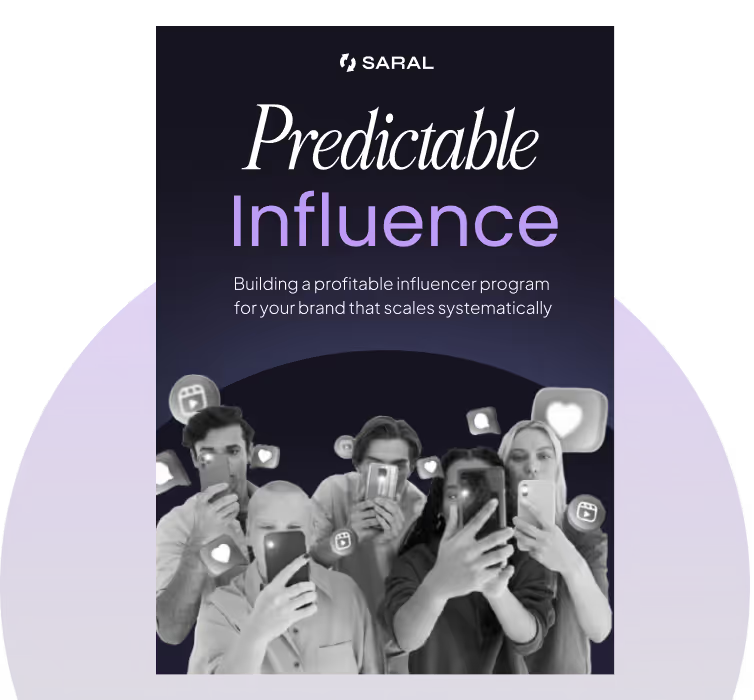
Sign up for a 7-day email course on the unique "Predictable Influence" strategy used by top brands like Grüns, Obvi, Tabs Chocolate.
.avif)
While competitors freeze budgets and hope for "normal" to return, antifragile brands are using economic uncertainty as their competitive advantage. This guide will give you strategies, psychology, and frameworks from 15+ DTC operators use to maintain growth during any crisis.

If ditching the randomness of influencer campaigns and building a predictable, ROI-first influencer program sounds like a plan. Consider talking to our team!
