



Ready to drive incremental growth with influencers?
If ditching the randomness of influencer campaigns and building a predictable, ROI-first influencer program sounds like a plan. Consider talking to our team!


Meta
Buying UGC videos every month is a costly cycle. See why influencer seeding is a smarter way to build a steady supply of content for partnership ads.

Contents
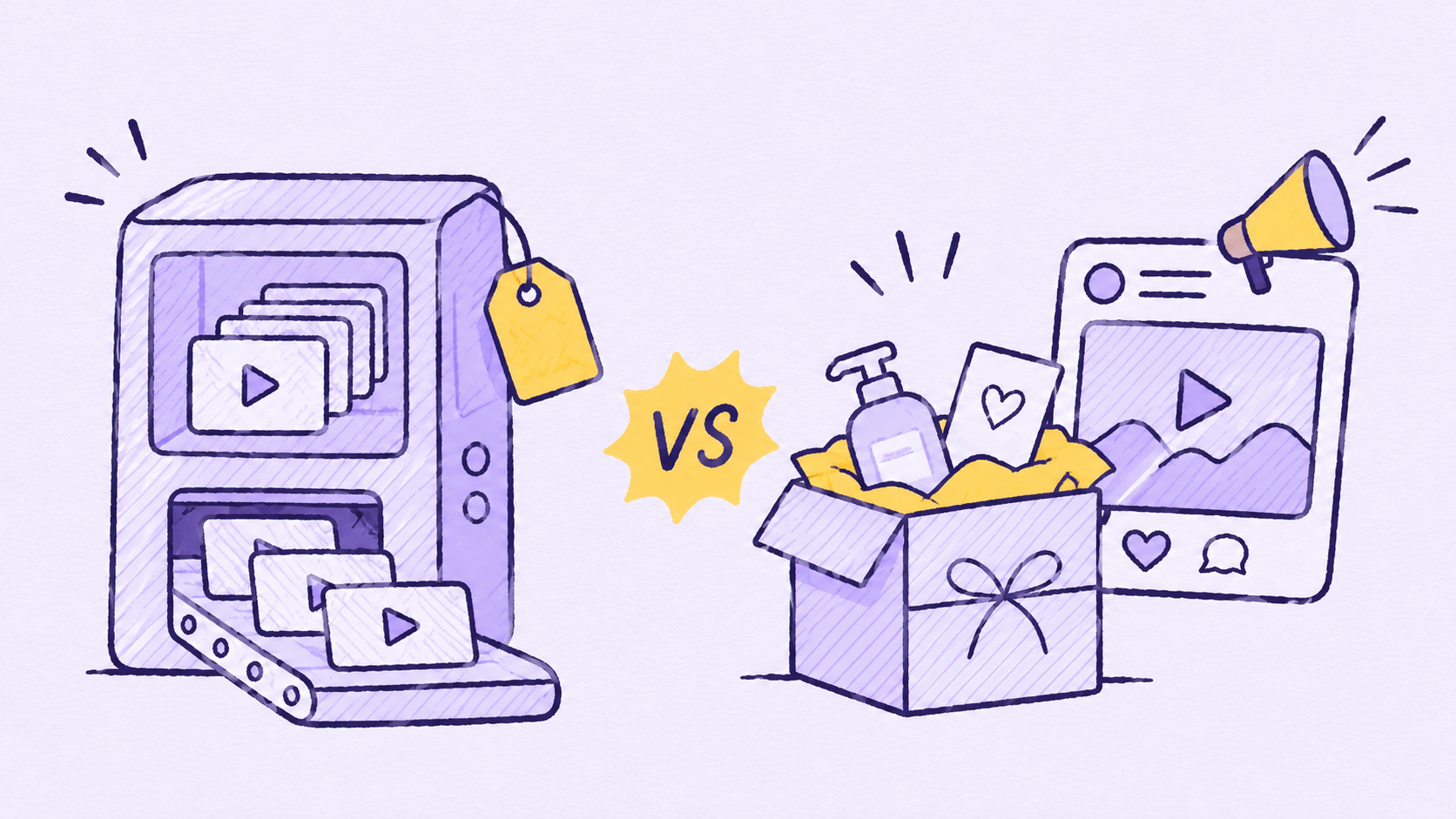
UGC marketplaces are a fast way to get video content for your ads, but they make a weak starting point for partnership ads. Building an influencer system that starts with seeding gives you a better foundation for three reasons:
A marketplace can get you videos in a week or two, which is useful when you have an immediate deadline. But when you need more content next month, you're back to buying another batch.
Seeding takes longer to get going, and the early results can feel less predictable. But, you build relationships with creators who keep posting, generating organic reach and giving you more content to use in ads. That ongoing value is what makes the extra effort worthwhile.
If you run Meta ads, you already know how quickly creative wears out. A common rule of thumb is to launch about one new ad for every $3,000 you spend in a month, so a brand spending $30K a month needs around ten new ads every month just to keep performance steady.
UGC platforms promise that you just write a brief, pay per video (which will be less than paying the creator directly), and get finished files back quickly, in a week or two. AI avatar tools are even quicker and can turn a script into a video in a few minutes. Prices start at around $100 per video and go up with length, extra hooks and variations. That sounds reasonable at first, though the per video price leaves a lot out.
The problems show up later, in four places:
There's also no guarantee that the videos you get will be good enough to use in ads. You might pay for ten videos and find that only three or four are worth testing as ads. Some might sound too scripted, have weak hooks, or just not be what you had in mind. Even with a detailed brief, a lot depends on the creator.
Bigger, well-known brands may have an easier time getting good videos because more creators want to work with them. Smaller brands can struggle to get enough submissions, let alone good ones.
Of course, seeding doesn't guarantee great content either. Some creators won't post at all, and some videos won't be worth using. But you get to see what creators make on their own before deciding which videos to put money behind.
Often it does, at least at first. Marketplace UGC usually beats polished brand creative, which is why these platforms keep growing and brands keep coming back to them. What matters for your ad budget is how long that advantage lasts once your audience has seen hundreds of ads made the same way.
In 1994, consumer researchers Marian Friestad and Michael Wright described something they called persuasion knowledge. Over time, people learn to spot the tactics advertisers use, and once they recognize a message as a sales attempt they start processing it with more skepticism. UGC ads worked so well in their early years because they slipped past this filter. They looked like a friend talking to a phone camera, so viewers watched them as content.
That window has been narrowing for a while because of:
People tend to pick up on a handful of signals:
With seeding, you can see how creators naturally talk about your product before investing further. You can identify those who explain benefits convincingly or share stories that resonate with their audience, giving you a stronger starting point for paid collaborations.
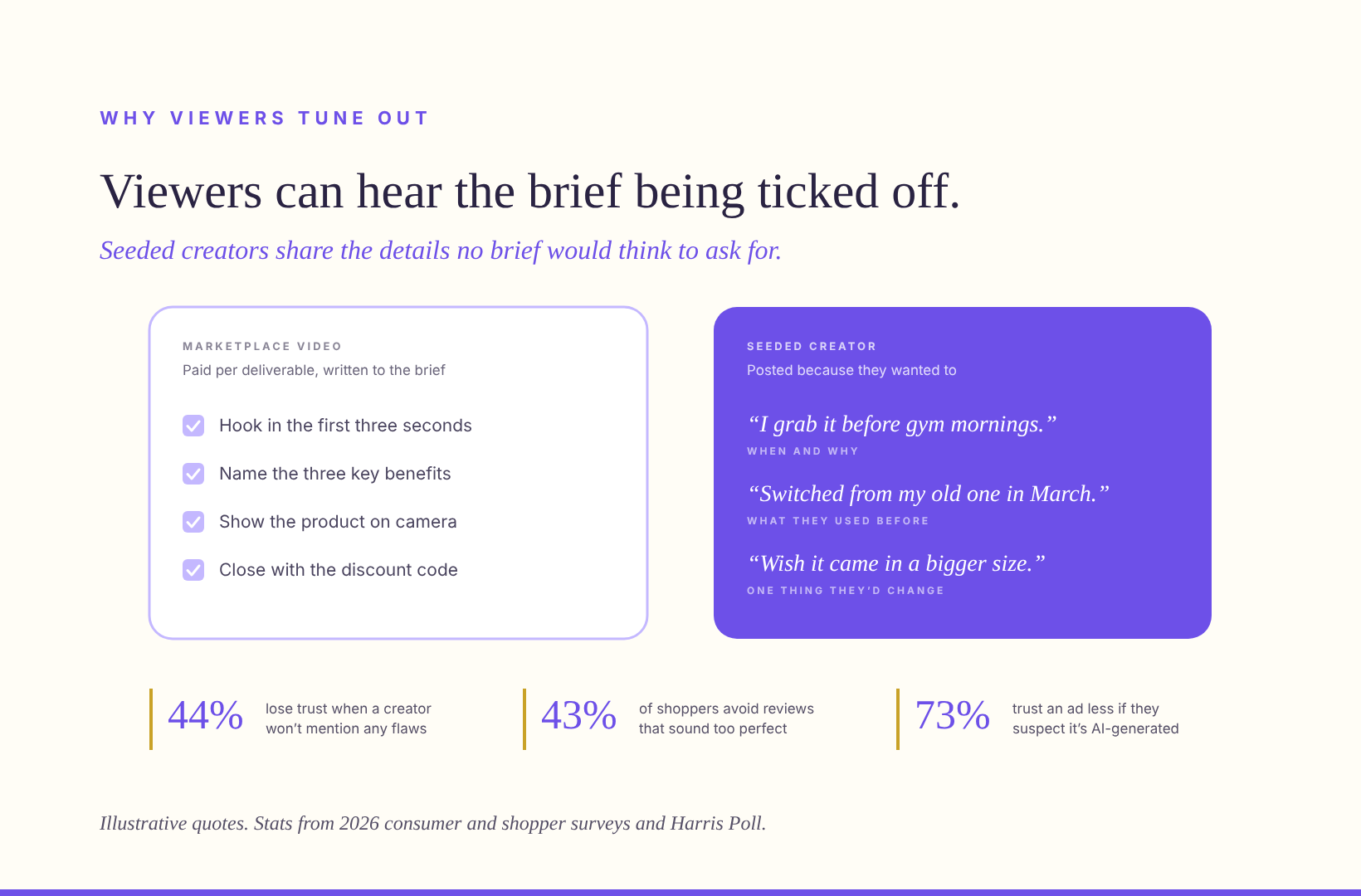
AI actors push this further. In Harris Poll research presented at Cannes in 2026, 73% of consumers said they would be less likely to trust an ad they suspected was AI generated.
Partnership ads show the creator's name next to your brand's in the ad header, and Meta uses signals from both accounts to decide who sees the ad.
That makes the creator's account part of how the ad performs. A 2026 industry report covering $130M in ad spend compared partnership ads with the same kind of UGC run from brand accounts.
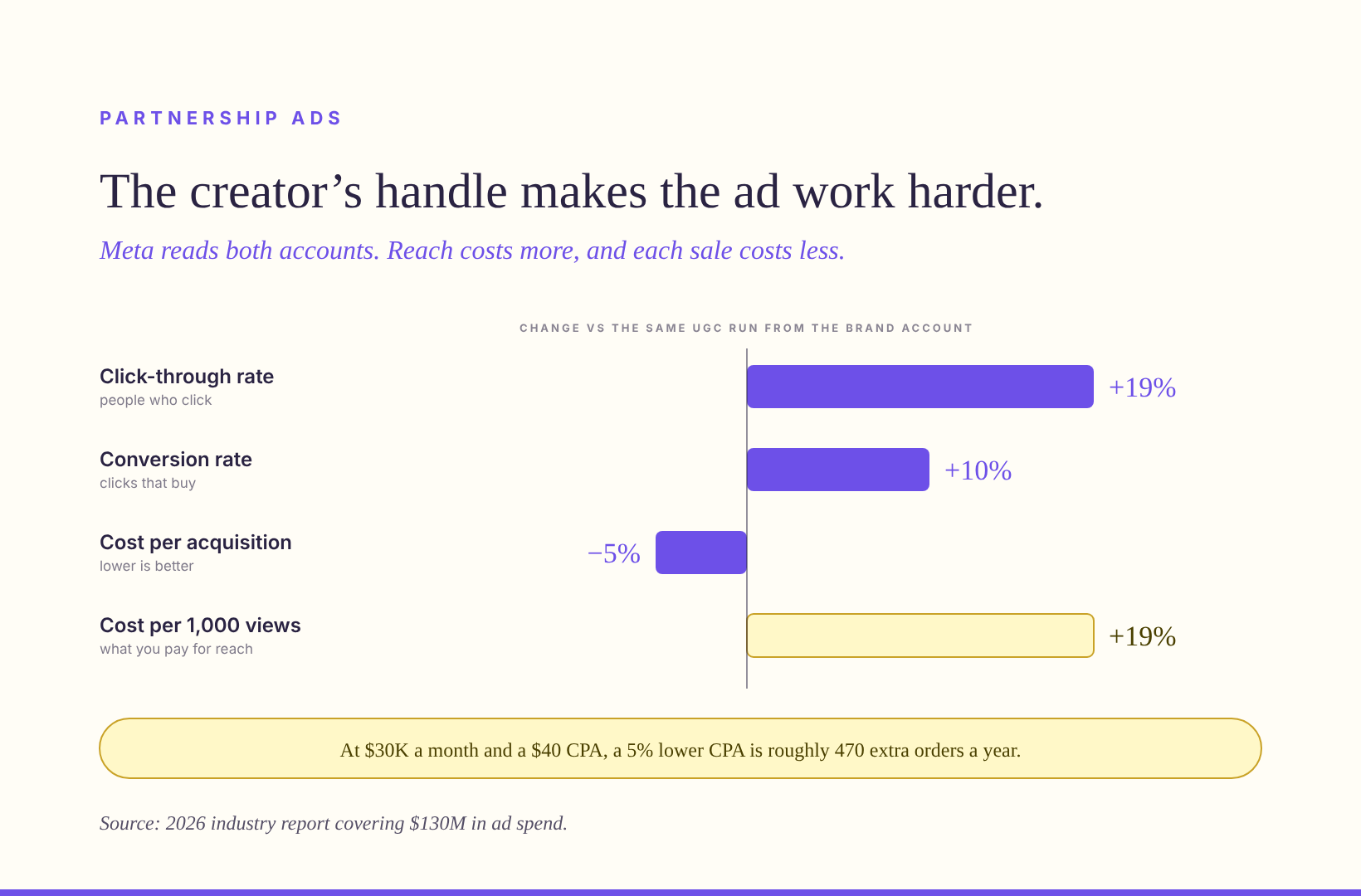
Partnership ads got 19% higher CTR, 10% higher conversion rate and 5% lower CPA, even with a 19% higher CPM.
The report put the difference down to Meta using the creator's followers and engagement history alongside the brand's pixel data.
So it matters where your creators come from.
Many marketplace creators run small portfolio accounts set up to win UGC gigs, often with a few hundred followers.
When you run their video as a partnership ad, Meta has very little extra to work with, and the ad performs much like a normal ad from your own page.
A creator with an engaged audience who has already posted about you brings real followers who have interacted with them, and often with your product too. If their face is familiar to part of your audience, the ad also carries some of the trust they have built over time.
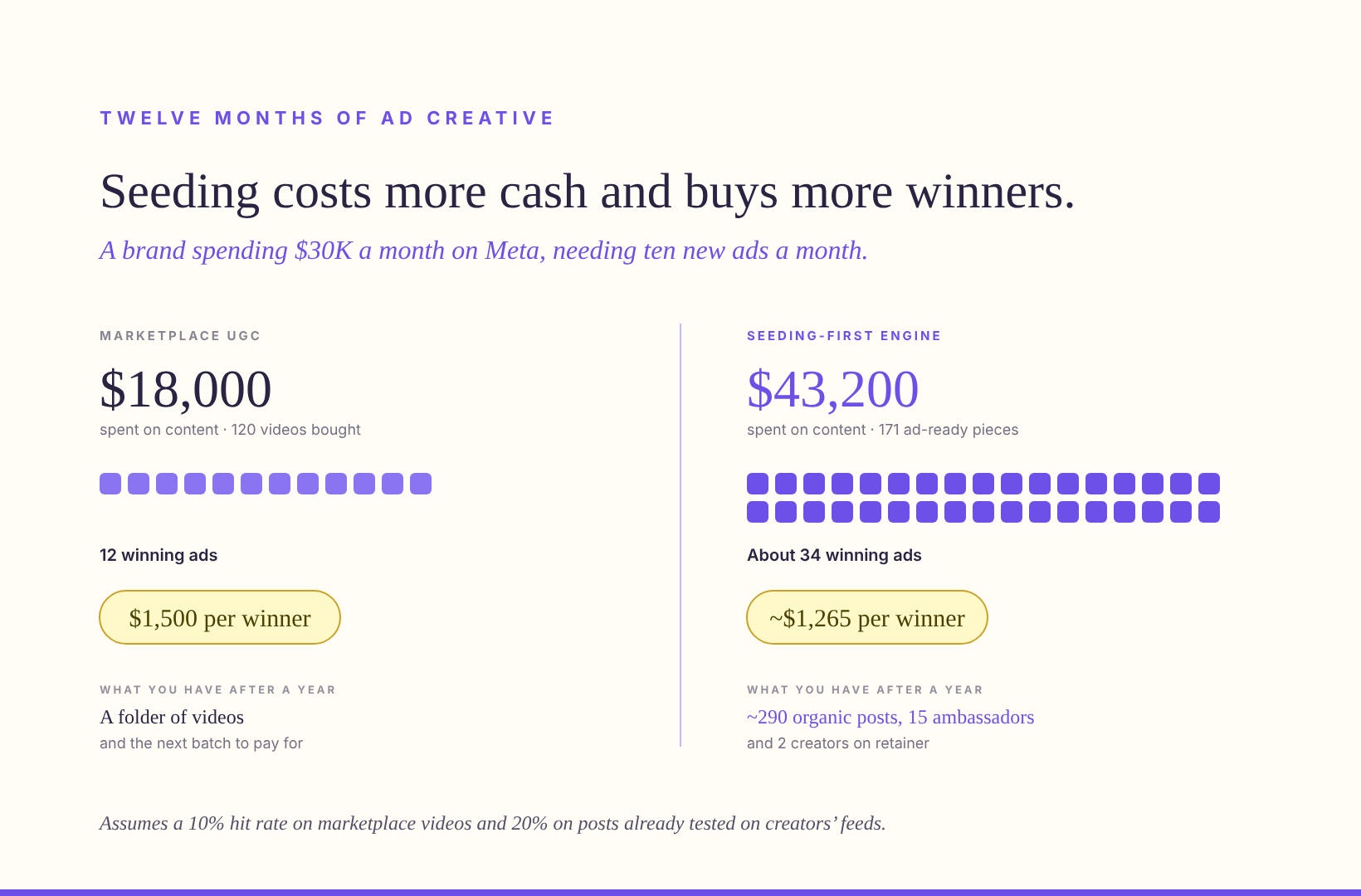
Let's take a brand that spends $30K a month on Meta, needs about ten new ad creatives a month, and has an average CPA of $40.
The brand orders ten videos a month at an average of $150 each, which allows for the add-ons most teams end up buying on top of a $99 base price. That comes to $1,500 a month and $18,000 for the year, for 120 videos.
If one in ten becomes a winning ad, the brand ends the year with 12 winners at about $1,500 each.
This route has two phases.
In months 1-3, the brand seeds 60 creators a month at $30 per package for product and shipping, which comes to $1,800.
Reaching out to 50 to 100 creators can produce 8 to 10 posts. The brand pays for usage rights on the best three at $300 each ($900). That is $2,700 a month for nine ad ready pieces.
From then onward, the creators who posted have joined an affiliate program, and around 15 of them post about 2-3 times a month. That gives the brand roughly 30 organic posts a month to pick from. Each month then looks like this:
The seeding route costs more in cash, but that spend also covers things the marketplace route doesn't give you: brand awareness from organic posts, sales through the creators' affiliate links, and a community of creators who keep posting about you without being paid per video.
If partnership ads run from engaged creator accounts deliver even the 5% lower CPA from that report, a brand spending $360K a year at a $40 CPA would get roughly 470 extra orders from the same budget.
You start by sending a product with no strings attached. From there, what creators post on their own tells you who to invest in, which content to run as ads, and who earns a longer partnership.
Pick creators whose followers look like your customers, and include existing customers who already post about products they use. Plan for 50 to 100 a month to start, since only a small share will end up posting.
With each package, add a short personal note saying they're welcome to share the product if they like it, with no obligation to post. Keep a simple log of who you sent to, when it arrived, and whether they replied.
Give each creator two to three weeks after delivery, then look at:
Offer them a commission (around 20% is common), a discount code for their audience, and perks like early access to new products. Then watch their next two or three posts. That's usually enough to show you who keeps posting because they genuinely like the product.
Wait until a post has clearly outperformed before you ask for rights, instead of building them into every agreement upfront. When you do ask, agree on where you'll run it, for how long, and the fee. Then set up partnership ad access from the creator's account so the ad runs under their handle.
Ask for variations on the angle that already worked, such as a new hook, a different use case or a shorter cut. Keep the brief to the key points so they can say it in their own words, because that's what made the first post work.
Some creators' content will keep turning into winning ads. Offer them a fixed monthly fee for a set number of ad-ready pieces, on top of their commission. To price it, look at what their past content earned you and how many posts it took to get there.
Each step filters for the same two things:
By the time you're paying for ad assets, most of the guesswork is gone.
A seeding-first program has a lot of moving parts, and most of them break down once you’re tracking dozens of creators in spreadsheets. SARAL handles the front half of the process: finding creators, sending outreach and follow-ups, shipping product, and setting up discount codes and affiliate links through Shopify.
PULSE, SARAL’s social listening engine, picks up from there. Once it’s connected to your Instagram or TikTok account, it automatically tracks every post, reel and story that mentions your brand, so you can:
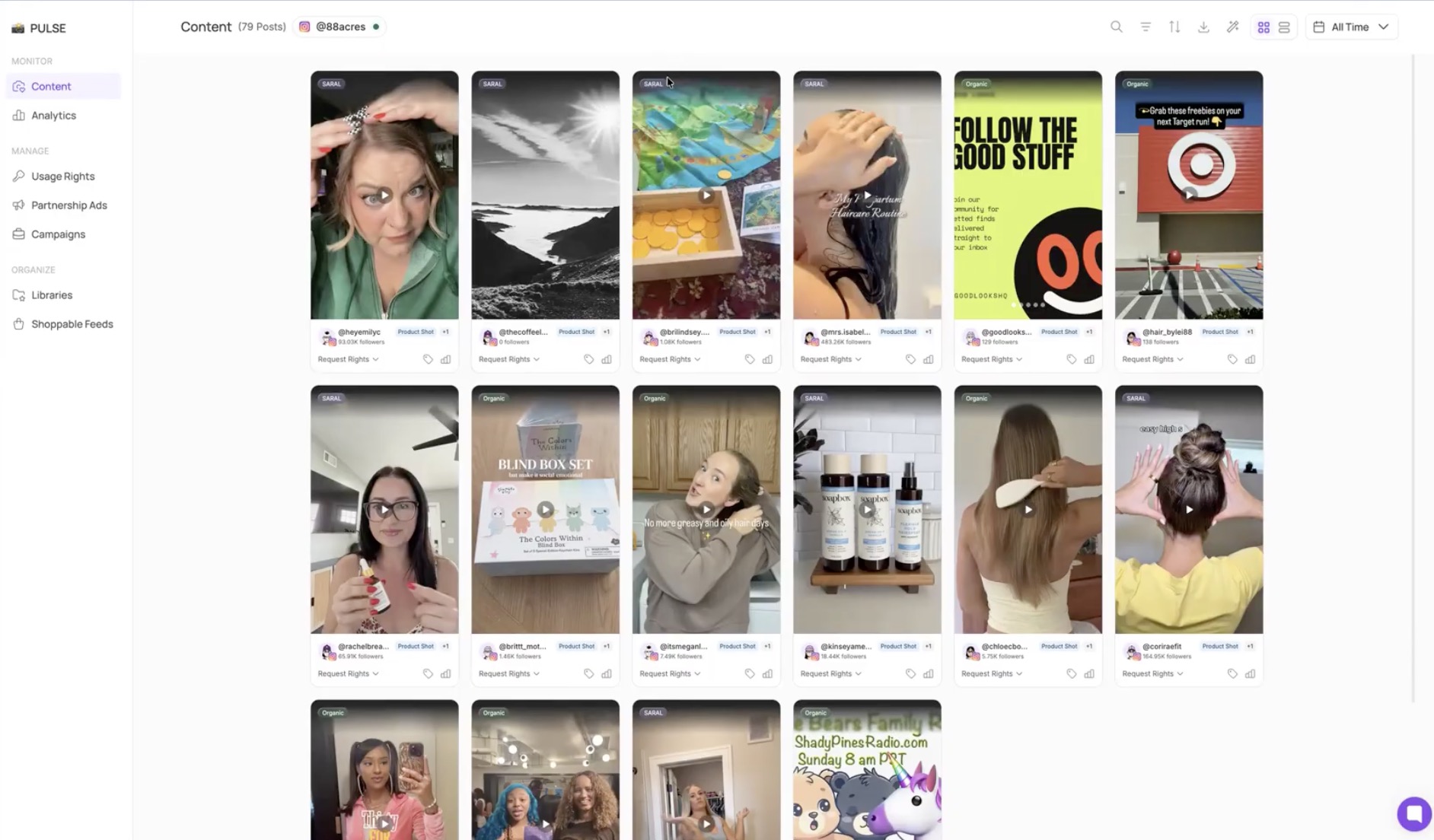
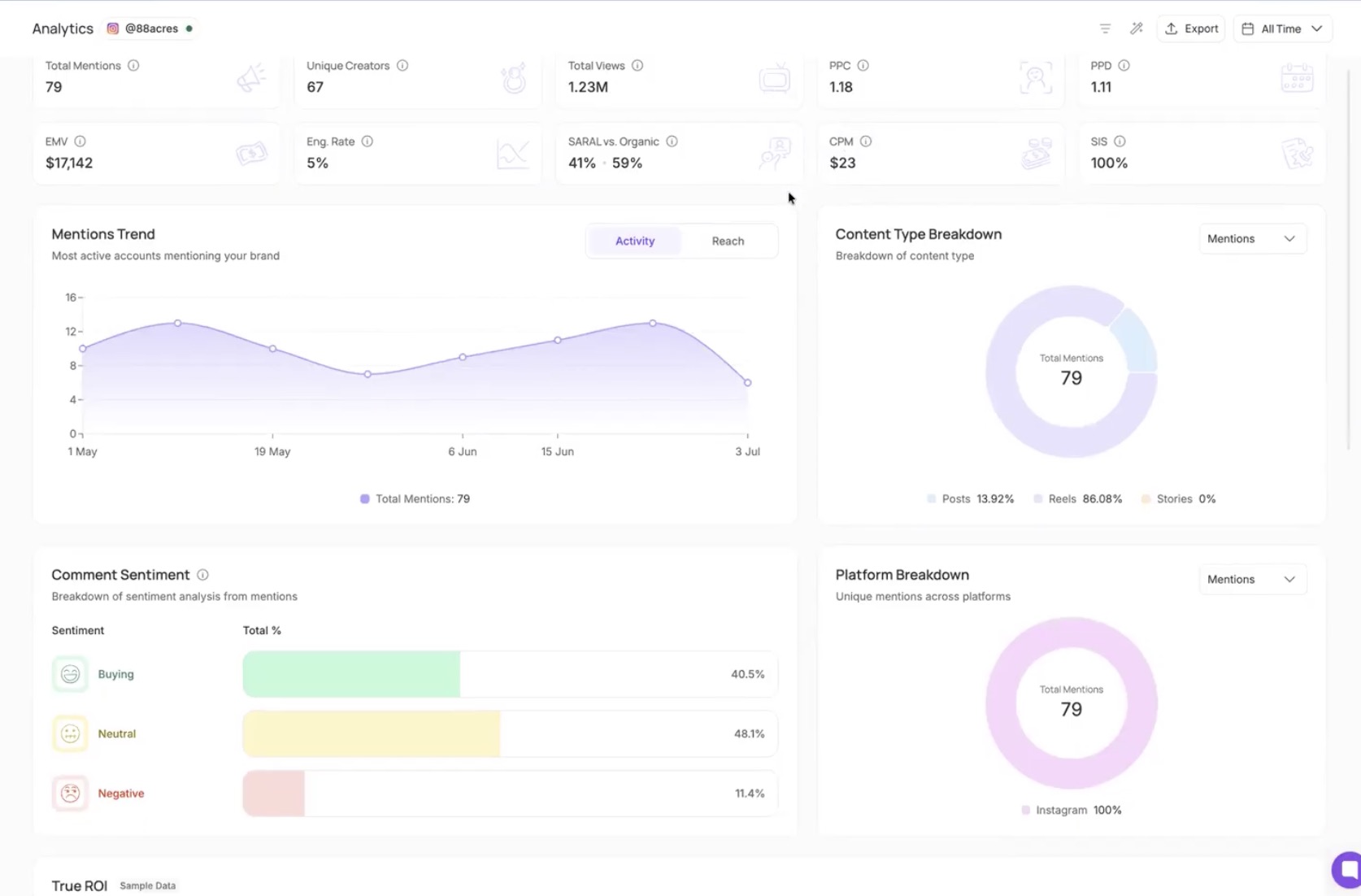
That means the content you find in can become a running partnership ad without leaving the platform or chasing creators through DMs.
A children's consumer brand found that some of its most compelling product stories came from parents and educators sharing their personal experiences.
Their chief marketing officer, described the value of these firsthand experiences:
"Where we really were seeing the magic of the brand come to life is when other moms and teachers would share their own personal experiences with their kids, with our products in their own words. I'm looking for content that's organically performing well, then we whitelist that."
The brand built a community of creators and encouraged them to share content in their own words, whenever it felt natural.
It then identified posts that were already performing well organically and turned them into paid partnership ads through creator whitelisting. This gave the brand a way to select ad creative based on how audiences had already responded to it.
Within nine months of the new approach:
The takeaway is that your existing creator posts can help you identify which content deserves paid promotion. Look at what's already getting a good response before deciding where to put your ad budget.
Marketplace UGC can still be useful in a few specific situations, mostly when cost or timing rules out seeding:
If you’re running ongoing Meta campaigns, the seeding program is where your effort and budget should go, since it keeps adding creators, proven content and organic reach over time, while every marketplace video costs the same as the last one.
Marketplace UGC will keep you supplied with videos, but you pay the same price every time and the creator’s account adds little when the ad runs. A seeding-first program takes a few months to get going. In return, every post, affiliate sale and winning ad adds to a roster of creators and a library of proven content that keeps growing the longer you run it.
The goal is to reach a point where, when your team needs new UGC for next month's ads, you already know several creators you'd be happy to work with again.
If you’d like to see what this looks like for your brand, book a consultative demo with the SARAL team. We’ll walk you through how brands use SARAL to find and seed creators, and how PULSE turns their best organic posts into partnership ads.
Sign up for a 7-day email course on the unique "Predictable Influence" strategy used by top brands like Grüns, Obvi, Tabs Chocolate.

If ditching the randomness of influencer campaigns and building a predictable, ROI-first influencer program sounds like a plan. Consider talking to our team!
