




.avif)
Ready to drive incremental growth with influencers?
If ditching the randomness of influencer campaigns and building a predictable, ROI-first influencer program sounds like a plan. Consider talking to our team!


Affiliate Marketing
Revenue in the dashboard doesn't mean your affiliate program is healthy. Walk through the most common money leaks and how to fix each one before they compound.


Contents
Once your affiliate program is up and running, it tends to just keep going. You check codes, ship product, and send the occasional nudge to creators. Revenue shows up in the dashboard, so you assume things are working.
But revenue showing up in the dashboard and a healthy program are two different things. Most affiliate programs lose money in ways that don't look like emergencies. A few creators get products but don't post. Or Commission rates that made sense a year ago no longer line up with today's margins. None of it feels urgent, so none of it gets caught, until the whole program starts looking unprofitable and the conclusion becomes "affiliate marketing doesn't work for us."
This is a walkthrough of the 5 most common places where affiliate programs leak. Run through it once a quarter. It takes less time than you'd think, and what you find usually pays for itself.
Your shipping list grows over time but rarely gets trimmed. Creators who posted consistently six months ago might have stopped. Maybe they lost interest, or maybe life got busy. But the product keeps going out every month because nobody paused to check.
Product + packaging + shipping adds up. Fast. 10 inactive affiliates at $30 a shipment is $300/month, going nowhere. Multiply that by 10 or 20 creators who haven't posted in weeks, and you're looking at a real line item that's producing nothing.
.jpg)
Pull a list of every creator you've shipped product to in the last 90 days. Next to each name, note the date of their last post mentioning your brand. Anyone who hasn't posted in 6 or more weeks gets flagged.
Set a rule that any creator who hasn't posted within 30 days of receiving product gets an automatic flag in your system. This way, you catch it early instead of discovering three months later that you've shipped $1,500 worth of product to someone who stopped posting long ago.
Send a simple check-in message to the creators. Here’s a script that works (edit it to match your tone):
"Hey, I wanted to make sure you're still enjoying [product]. We noticed it's been a while since you shared anything and wanted to see if everything's good on your end."
Some of them will not reply at all. You can remove those from your shipping list. You can always restart later if they re-engage. But keeping them on the list by default is how the leak keeps dripping.
Coupon leakage is one of the most frustrating ways affiliate programs lose money.
A discount code meant for a specific creator gets scraped, republished on a deal site, and that creates a bunch of problems for everyone involved:
Look for the telltale sign: a creator's code is generating orders, but they haven't posted recently (or at all). If you see high sales volume with no corresponding content activity, that's a signal that the code has leaked.
You can Google the creator's code and see if it shows up on coupon aggregator sites.
Legitimate sales show a pattern of clicks followed by orders. Leaked codes show lots of orders with no corresponding clicks, because customers are typing the code in directly at checkout instead of coming through the creator's link.
Link-based attribution is the cleanest solution on paper. The discount gets applied automatically when a customer clicks through a creator's unique link, so there's no code to scrape or republish. But in practice, creators prefer code. Codes are easier to share in stories, mention in videos, and drop in captions. Asking creators to only use links adds friction to the workflow.
A more practical fix is to use tools that are built to protect your revenue while still letting creators use code. SATHI's fraud engine detects when codes get picked up by coupon sites and intercepts those uses, so commissions go to the creator who actually drove the sale.
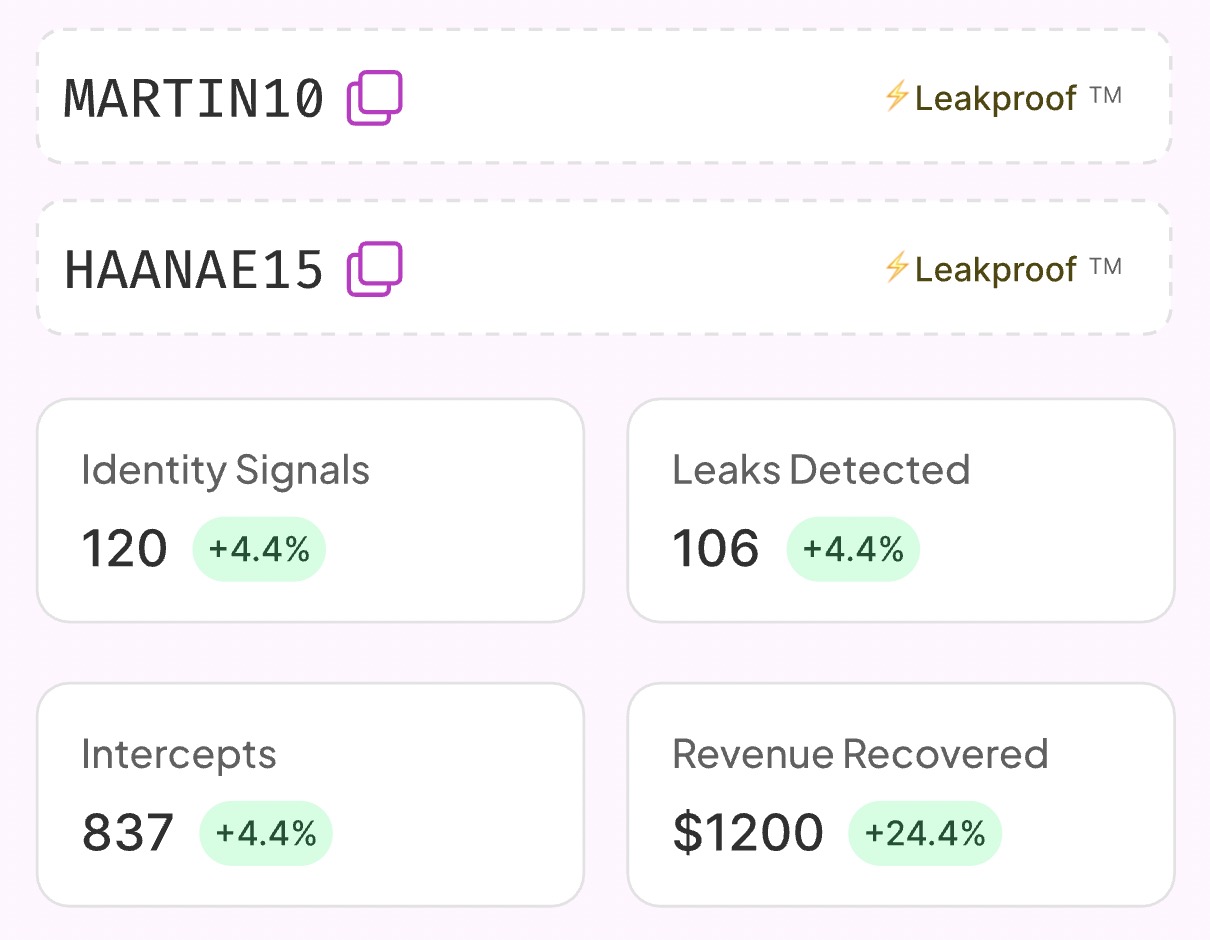
For codes that have already leaked, update the creator's referral code immediately and let them know. Send a message: "Hey, we noticed your code ended up on a coupon site during a routine check. We've refreshed it to protect your commissions going forward."
A flat commission structure works against you in two directions at once.
Your best performers have no reason to push harder because hitting 5x the sales of the next affiliate earns them the same percentage. That gap between what they're doing now and what they'd do if there was something to chase is real revenue sitting on the table. And when top performers feel like effort doesn't lead to a better deal, they start giving that energy to brand programs that do reward results.
On the other end, you're paying brand new affiliates the same generous rate before they've proven they can sell anything at all.
Build tiers into your commission structure. Start new affiliates at a base rate and let them unlock higher percentages as they hit sales milestones. Even two or three tiers with clear thresholds are enough.
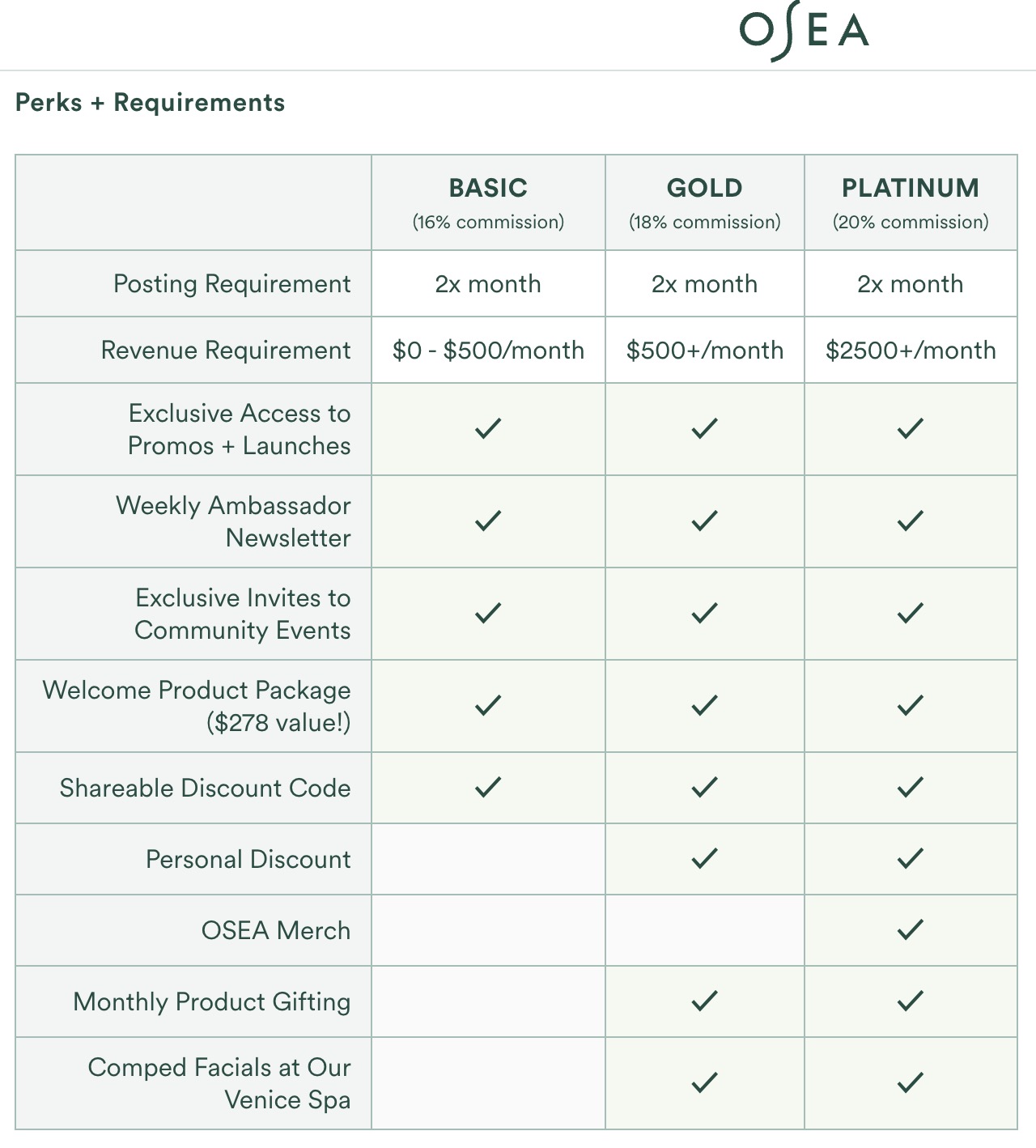
Here's a good example from OSEA. They have three tiers: Basic (16% commission), Gold (18%), and Platinum (20%). Each tier has a clear revenue requirement. Basic is $0-$500/month, Gold kicks in at $500+/month, and Platinum requires $2,500+/month. And the perks scale with performance, too.
A customer finds your brand through a creator, uses their code, and loves the product.
They come back a month later and order again, using the same code because it saves them 15%.
They come back a third time, a fourth time. By now, they're a loyal customer who would buy from you regardless. But every single order still triggers a commission payment to the affiliate.
The creator drove that first sale. Maybe even the second. But by the fifth or sixth order, that customer is yours. They're just using the code out of habit because it gives them a discount.
Across your whole program, this adds up. If you have affiliates with high repeat-purchase rates on their codes, a chunk of the commission you're paying is going toward sales that would have happened at full price without any affiliate involvement.
Export the order data tied to each affiliate code and look at the customer emails behind those orders. How many unique customers vs. repeat customers are there? If an affiliate's code shows 50 orders last quarter but those came from only 12 customers, most of that revenue is repeat purchases.
You can also check the time between a customer's first order and their most recent one. If someone first bought through a creator's code eight months ago and is still using it, they're long past the point where the creator is influencing their buying decision.
Set a commission window. Pay the affiliate commission on the first purchase (and maybe the second) from each customer, then stop attributing future orders to that affiliate.
Some brands handle this by switching repeat customers to a general loyalty discount that isn't tied to any affiliate code, so the customer still feels rewarded, but the sales commission stops leaking.
Check if your commission rate still makes sense for your current margins.
It's possible that when the program launched, the commission was set a little higher to attract good affiliates. Since then, your product costs may have gone up, you may have added new products with different margins, or you may have started running more frequent site-wide promotions. But the commission rate stayed where it was.
A rate that made sense when your margins were healthy might be eating into your profit now. And if you've added lower-margin products to your catalog, affiliates earning the same flat percentage on those items could mean you're barely breaking even on some sales, or losing money once you factor in the product you gifted them.
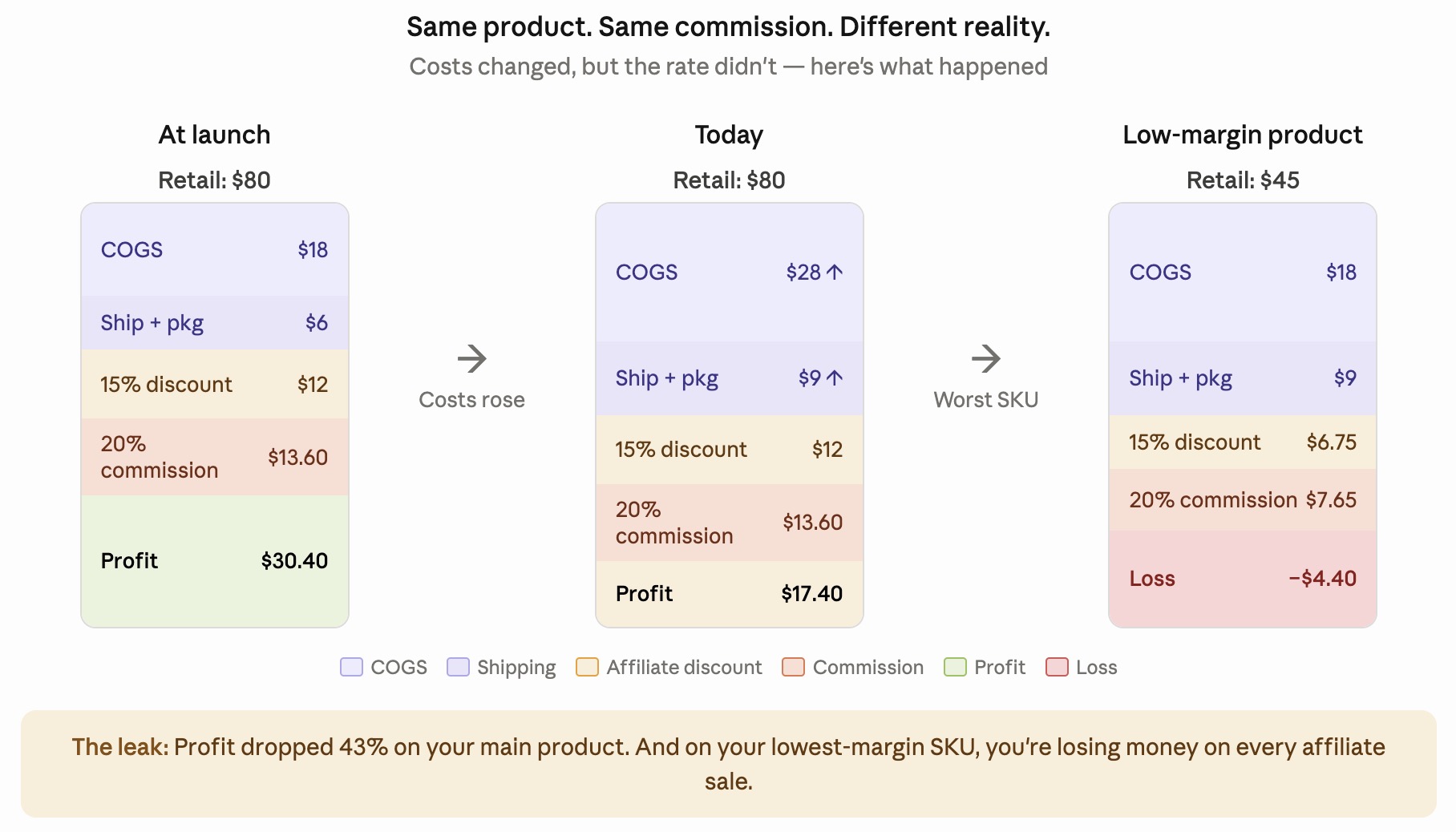
Take your top 5 products that affiliates sell the most. For each one, do this calculation:
Product retail price - affiliate discount (e.g., 15% off) - affiliate commission (e.g,. 20%) - COGS - shipping & packaging = what you actually make on that sale
Ask your ops or finance team for the current unit economics on those products. Then run this calculation twice: once with the costs from when the commission rate was originally set, and once with today's costs. The gap between those two numbers is your leak.
If you find that some products are barely profitable (or not profitable at all) after the affiliate discount and commission stack on top of current costs, that's your signal to adjust.
Don't try to set different commission rates per product category. That creates confusion for creators and becomes a nightmare to communicate with influencers and manage.
Instead, look at your lowest-margin product. That's your floor. If the thinnest margin across your catalog is 30%, and you're paying 20% commission plus a 15% affiliate discount, you're underwater on every sale of that product. Your commission rate needs to work even for your worst-case SKU, because a customer coming through an affiliate link can buy anything on your site.
So find your baseline: the minimum margin across all the products an affiliate could realistically sell. Your commission rate should sit comfortably below that number, after accounting for the affiliate discount. If it doesn't, the rate needs to come down.
Fixing leaks gets your program back to where it should be. But it doesn't automatically make it grow. Most affiliate programs plateau because they don't have a clear path for creators to move through. New affiliates come in, some post, some don't, and the ones who do well just keep doing the same thing at the same level.
The programs that actually compound have a structure behind them. They start with seeding product to a wide pool of creators. The ones who post and show genuine interest get brought into an ambassador program with commissions and ongoing product. And the small percentage who consistently drive real revenue get moved into custom partnerships with better rates, retainers, or exclusive perks.
That progression is what turns an affiliate program from a list of creators with discount codes into a real growth channel. We broke down the full framework in a guide. If you've done the audit and your program is running clean, this is what to focus on next.
Build a predictable influencer program →
Sign up for a 7-day email course on the unique "Predictable Influence" strategy used by top brands like Grüns, Obvi, Tabs Chocolate.

If ditching the randomness of influencer campaigns and building a predictable, ROI-first influencer program sounds like a plan. Consider talking to our team!
