



Ready to drive incremental growth with influencers?
If ditching the randomness of influencer campaigns and building a predictable, ROI-first influencer program sounds like a plan. Consider talking to our team!


Four years of working together. Here's how one of the UK's leading marketing science agencies thinks about influence, measurement, and scale — and what any agency can take from it.
.png)
Contents
Charlie Oscar started as an investment business that incubated DTC brands: deploying data scientists, growth strategists, and brand consultants to help companies scale. When they transitioned to a full agency model, that marketing science foundation came with them.
Today they work with brands like Gymshark, Different Dog, and Flo. And for the past four years, SARAL has been the operational backbone of how they run influencer programs at scale.
What makes their approach worth understanding is how they think about influencers as a growth channel for e-commerce brands.
For years, influencer marketing had an innovation gap.
Platforms got better at tracking posts, measuring engagement rates, and pulling reach data. But the measurement stopped there. Brands had vanity metrics and not much else.
"A lot of brands unfortunately got stuck in this system where when it came to the measurement of their work, they only really had vanity metrics to play with. That definitely worked for a while. But as businesses mature, they need to really show where every dollar is going."
The gap wasn't anyone's fault. The tools just hadn't caught up. And in the absence of better measurement, influencer marketing stayed in the brand channel bucket — useful but unprovable, which made it permanently vulnerable in budget conversations.
Charlie Oscar set out to close that gap. Working with their co-founder Dan Wilson, who has spent his career building Marketing Mix Models for traditional channels, they built Compass — a measurement framework that brings influencer data into the same models used for paid search, paid social, and out-of-home.
What they found when they did changed how they think about the channel entirely.
When Charlie Oscar started feeding influencer data into MMM, the finding was significant: 80% of influencer-driven revenue is indirect.
It doesn't come from someone clicking a link or redeeming a code.
It comes from someone who saw a creator talk about a brand, went back to their life, and eventually bought through Google, a retargeting ad, or direct traffic days or weeks later.
"That 80% would have been re-attributed to another channel. But the theory is: influencers still directed people to convert. Influencer marketers have been at a disservice for so long with what they had available to measure the channel."
This is the number that changes the budget conversation. The revenue is there. The attribution model just wasn't looking in the right place.
Last-click attribution is incomplete, yes but it also drives the wrong decisions.
Programs that are building brand trust and warming audiences get paused because the dashboard doesn't show it.
Creators doing awareness work get cut because their codes aren't converting. Budgets shift back to paid channels that capture demand without anyone asking who created it.
"Last-click doesn't match up to real consumer behavior. People are scrolling. They might see a code or a link, but they're going to buy days, weeks later through a completely different channel. But they were still influenced. And that's what direct attribution can't capture."
The downstream effects show up in paid media performance.
Charlie Oscar consistently sees CPA and CAC improve by upwards of 50% when running influencer content in paid campaigns versus brand-shot creative. That efficiency gain doesn't show up under influencer in the attribution model — but it only exists because of influencer reach.
So what’s the solution?
Showing up with better numbers.
Charlie Oscar's Compass framework makes influencer data actionable in ways vanity metrics never could be; down to which niches drive the most revenue uplift, which content formats move the needle, and which platforms are worth doubling down on.
"You can literally go as detailed as you want if you have the right amount of data. We can actually start to understand what niches work best, what content formats work best, what platform works best, and then optimize or guide strategy from there."
Once you can show leadership that influencer activity is lifting paid social efficiency, driving branded search, and contributing to revenue that previously got credited elsewhere, the channel earns its place in the media mix.
"It really allows influencers to stand as their own mature channel, right there beside the channels that brands typically funnel the most investment into."
Want to go deeper on influencer measurement? Charlie Oscar's Dan Wilson and Sasha Jeppesen joined SARAL for a full session on how to measure influencer impact beyond the dashboard, including how MMM works in practice and what signals to bring to your next budget conversation.
Watch the webinar→
Knowing what to measure is one thing. Building programs large enough to generate the data that makes measurement meaningful is another.
Charlie Oscar runs influencer programs across multiple brands simultaneously. At that volume, the operational needs are specific, and unforgiving.
"I look back on times where we were screenshotting stuff and putting it into an Excel sheet. Stop right now if you're still doing that."
Four operational problems come up every time a program tries to scale:
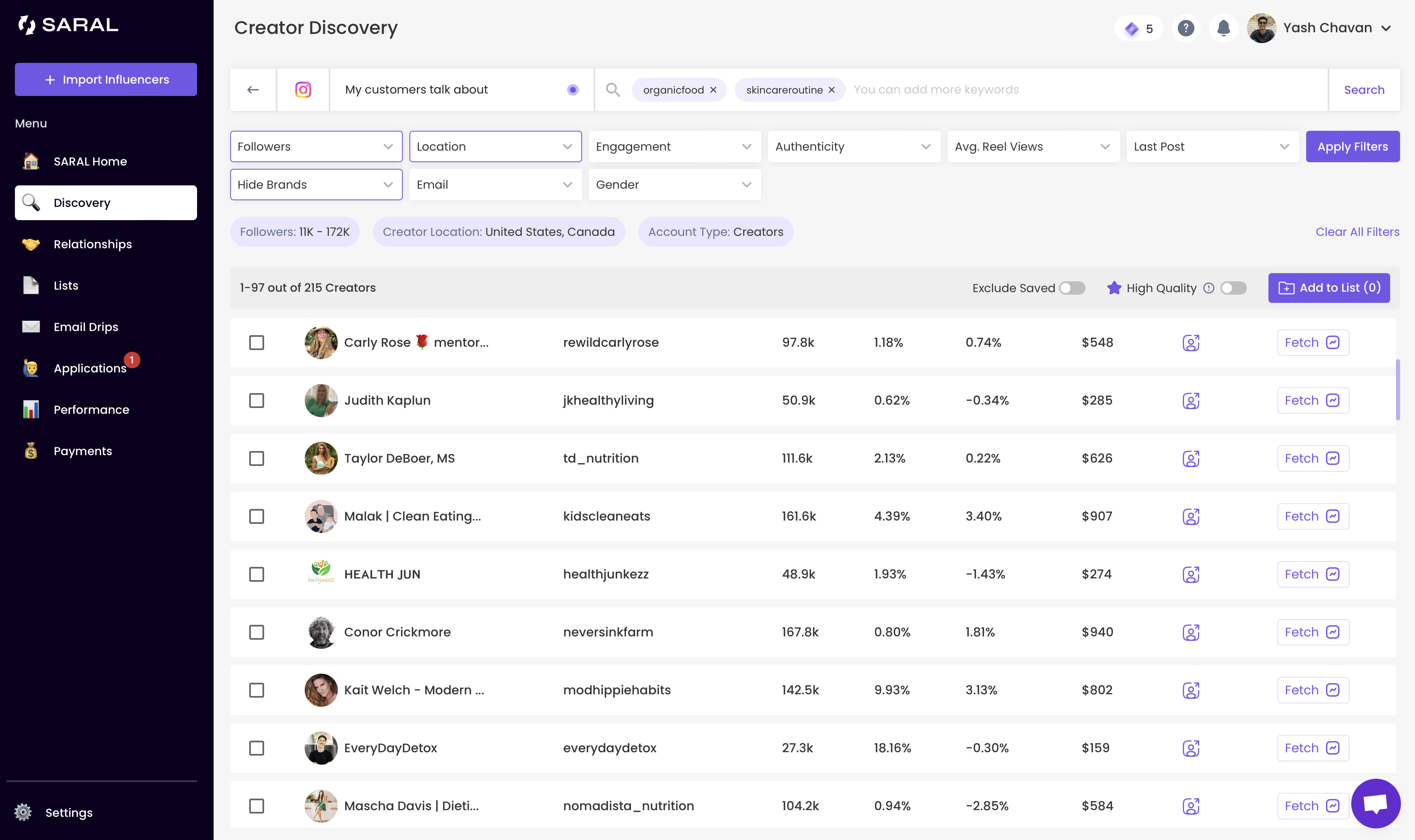
Manually scrolling platforms to source influencers is a bottleneck.
SARAL's discovery lets teams filter and build lists at volume, with human review happening after the list is built rather than during it.
Sending product to hundreds of creators means address collection, tracking, and coordination across multiple moving parts. SARAL connects to the brand's backend so product ships and tracks without manual intervention.

Reaching out to 100 creators and chasing each one manually doesn't scale.
SARAL's outreach sequences handle follow-ups automatically, so the team's attention goes to the relationships that are responding.
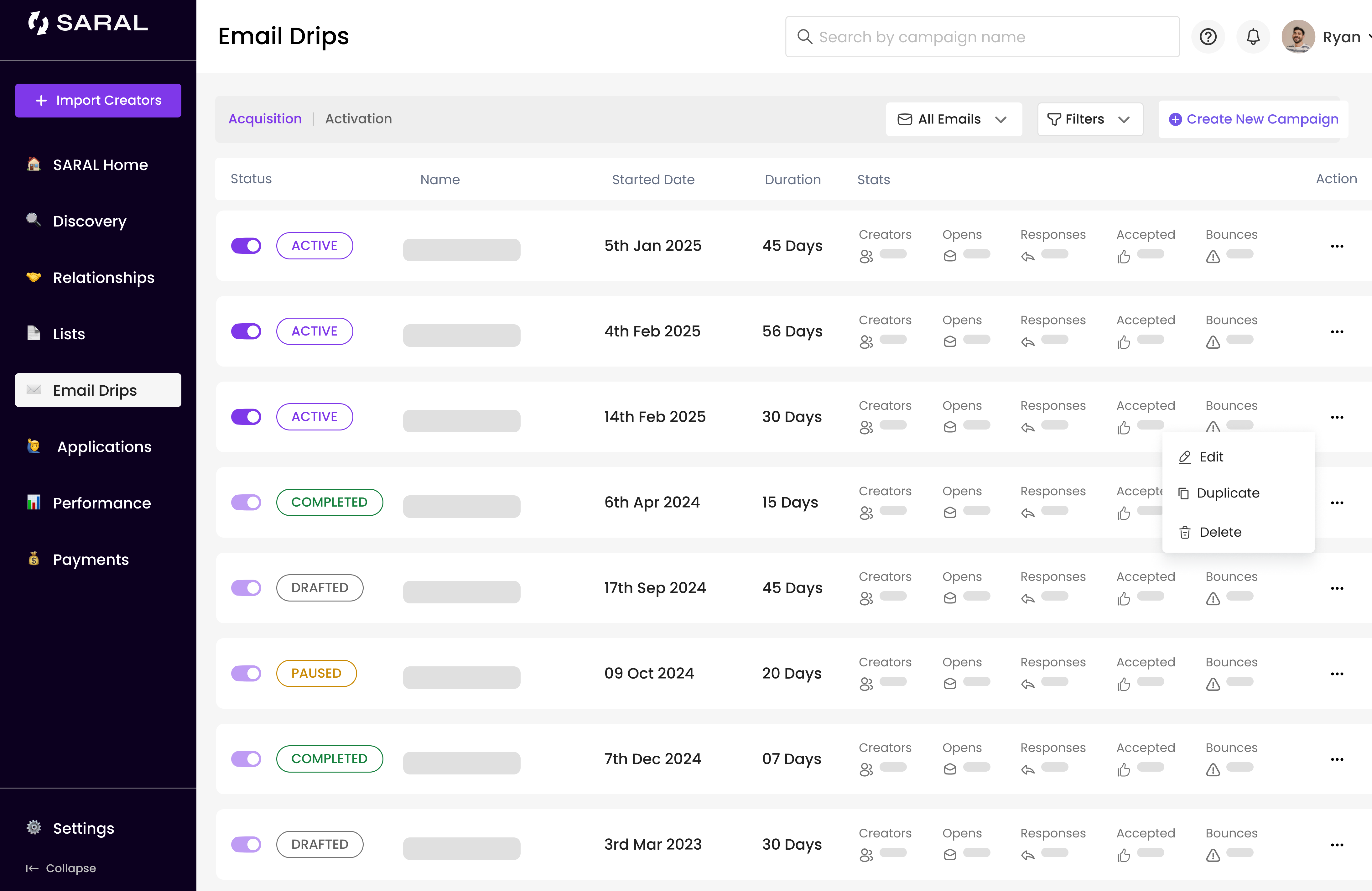
Knowing who posted what and when used to be a manual job. SARAL tracks content automatically so nothing falls through the cracks and reporting doesn't take a day to pull together.
Charlie Oscar found SARAL almost four years ago, initially for the shipping feature, which Sasha describes as ahead of its time. But what kept the relationship going was something beyond the product.
"It felt like we were building together. The amount of openness around us providing feedback — you even built features for us that weren't available before. It wasn't just off the shelf. It was a values alignment of people who are just as passionate and want to build something great."
Sasha spends a lot of time thinking about where the channel goes from here. A few directions she sees clearly.
Short form will always have a place. But brands are starting to invest in influencer IP — series, shows, episodic content on YouTube and TikTok that commands real attention rather than a scroll-past.
"I think people really are starting to invest longer amounts of time of their attention to more entertaining pieces. How can influencers start to infiltrate those spaces more traditionally?"
The model of brands handing a brief to a creator is evolving into something more collaborative — where creators are involved in product development, not just promotion. Sasha points to brands in the US already achieving significant growth through these kinds of partnerships.
The era of vanity metrics is ending. As more agencies adopt MMM and proper attribution frameworks, influencer marketing will be held to the same standard as every other channel — and will be able to defend its place in the mix because of it.
The Charlie Oscar model works because measurement and operational infrastructure aren't separate workstreams — they feed each other. Programs running at scale generate the volume of activity that makes the models meaningful. The models tell you where to put that activity next.
"Being able to show how influencers can help the other channels and make them more efficient — how it's all working as an ecosystem, not just in silo — has been really exciting. Clients say 'I've never had buy-in before. No one ever believed in the channel. Charlie Oscar has single-handedly allowed influencers to be seen as a respectable channel for the business.'"
That's the outcome this approach is designed to create: an influencer program that earns its place in the media mix because the numbers support it.
Ready to build a program you can prove?
Want to get results like Charlie Oscar?


See how SARAL can work for your brand.

Want to get results like Charlie Oscar?

If ditching the randomness of influencer campaigns and building a predictable, ROI-first influencer program sounds like a plan. Consider talking to our team!
