

.avif)


Ready to drive incremental growth with influencers?
If ditching the randomness of influencer campaigns and building a predictable, ROI-first influencer program sounds like a plan. Consider talking to our team!


Influencer Outreach
Learn when to follow up with influencers, what to say at each stage, and how to keep conversations moving without sounding pushy.


Contents
You sent 50 outreach messages to influencers last week. Three replied. Now there are 47 quiet threads sitting in your inbox, and the same question keeps coming up.
“Should there be a follow-up, or would that just be annoying?”
Most of the time, that silence has nothing to do with a lack of interest. Influencers are buried in emails and DMs. Messages get opened at the wrong moment or pushed down by the next hundred notifications. That’s why follow-ups matter, and why having a clear way to do them makes a real difference.
In this article, we’ll walk through a simple, practical follow-up system. You'll learn when to follow up, what to say at each stage, and how to use comments alongside DMs or email.
When you don't get a reply to your first message, don't assume that influencers are thinking “no thanks.” They might be thinking, “I’ll reply later,” and then the message disappears under everything else.
This is why following up isn’t awkward or annoying. It’s just how real conversations actually happen.
Keep in mind:
If you’ve tried following up before and it didn’t work, it usually wasn’t because follow-ups don’t work.
It was because the follow-up didn’t make it easier to reply. Maybe it came too fast, maybe it was too long, or maybe it didn’t clearly say what the next step was.
Let’s break down a follow-up sequence that works without feeling pushy.
If you’ve sent the first message and heard nothing, below is a sequence of emails / DMs that you can follow.
These timelines are meant to be a starting point, not a strict rule. How often you follow up will depend a lot on the type of creators you work with.
For example, creators who are new moms or caregivers may need more time and extra nudges.
Others might prefer quicker, more direct check-ins.
Pay attention to response patterns and adjust your timing based on what actually works for your audience.
In this first follow-up, you’re not trying to convince them of anything. You’re just making sure the message didn’t get buried, which happens constantly.
Send a short nudge in the same channel where you contacted before (email → email, DM → DM). Keep it one or two lines.
Template you can use:
“Hey [name of influencer], just bumping this in case my earlier note about collaboration with [brand name] got lost. Happy to send you the product if you’re open to it.”
By this point, there’s a good chance the creator has already seen your message. The lack of reply usually isn’t because they’re uninterested. It’s because they didn’t yet have a clear enough reason to stop and respond.
This follow-up is about giving them that reason.
Point to something specific in their content and connect it directly to your product so the value clicks quickly.
For example, you can say something like this:
“Following up because your recent [type of content or post] made me think that [product or offer] from [brand name] would fit your content really well. If you’re open to trying it, I can [next simple step, like ship it this week or send details]”
The goal of follow-up 3 is to remove whatever might be holding them back. This message clears those doubts and gives them enough confidence to decide without pressure.
You can include:
a) Light social proof
Add something to show that you’re a real brand working with real people.
“We’ve been sending this to a small group of creators in your niche, and they’ve been sharing some great results.”
This helps them feel like they’re not taking a risk by saying yes.
b) Soft objection clearer
Sometimes creators hesitate because they assume there are strings attached, it’s too much effort, or you expect a guaranteed post.
You can remove that pressure by saying something like:
“There’s no obligation to post. Just try it and see if it fits your content.”
c) Time-bound detail (only if true)
If you’re closing out a gifting round, have limited inventory, or are only working with a small batch of creators, you can mention it here. It gives them a reason to reply now instead of later.
“If helpful to know, we’re finishing up this round of gifting soon, so I just wanted to check in once more in case you were interested.”
This is your closing note. Let them know you will not keep following up, and make it easy for them to reach you later if the timing ever works.
“Hey [Name],
I’ll make this my last message so I don’t crowd your inbox. If now isn’t the right time, that’s completely fine. If you ever want to try [brand name]'s product or explore something together later, you can reach me at [email].
And if you’d like to check out our products on your own at any point, feel free to use this [discount percentage] code: [code].
Hope you have a great week.”
These templates and sequences work for any type of product or type of influencer. But what doesn't work is trying to manage all of it manually. You'll forget who needs a nudge or who replied.
This is where having the right system helps. In SARAL, follow-ups don’t live in your head or in a spreadsheet.
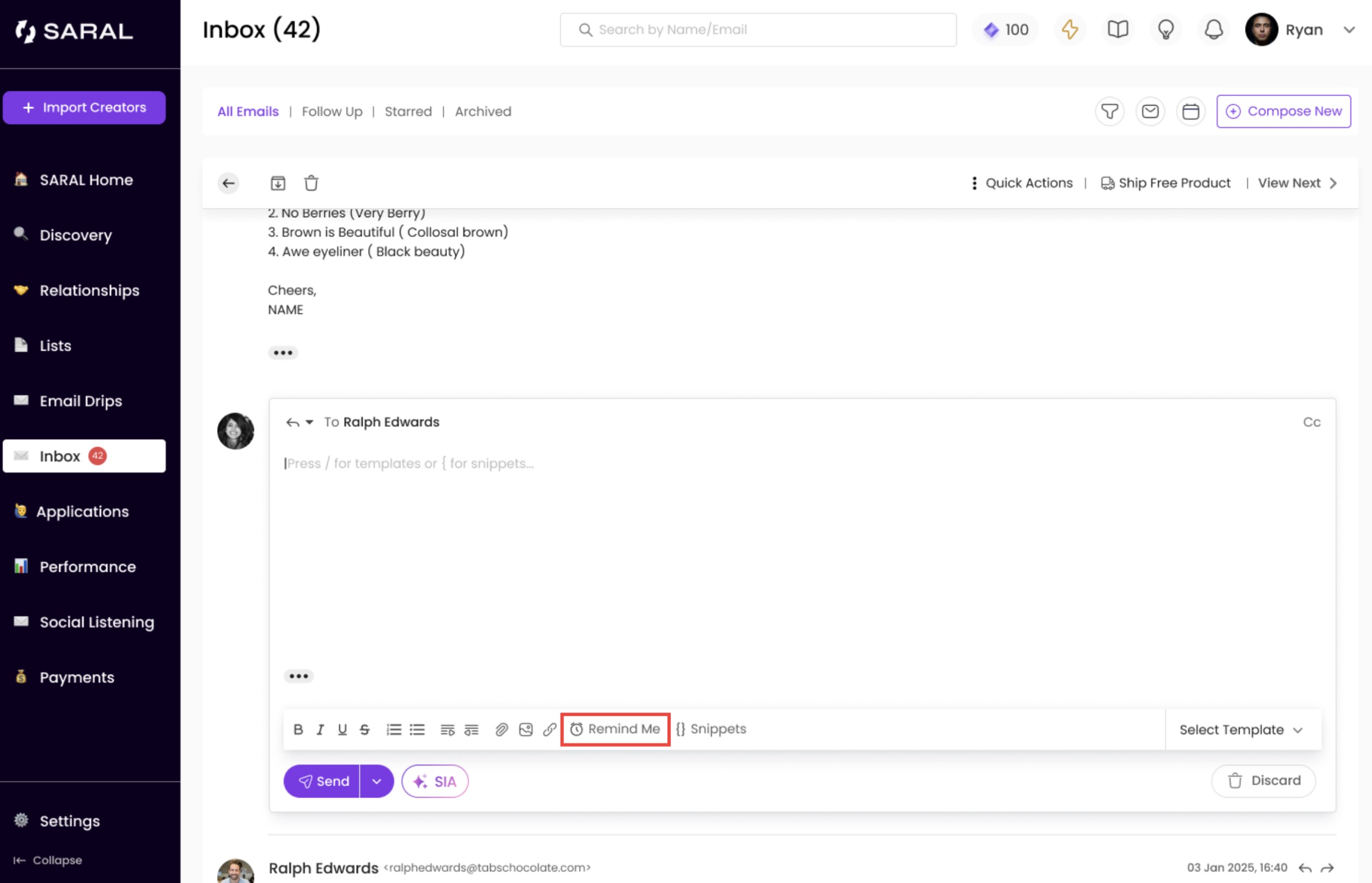
While replying to an influencer or composing a message, you can set a reminder for the exact number of days you want to follow up. SARAL brings it back to you automatically, so conversations don’t stall and good leads don’t get forgotten. It’s a small feature, but it makes consistent follow-up feel effortless instead of exhausting.
Book a consultative demo of SARAL here, and let us show you how it can help run your entire influencer marketing program.
Follow-ups don’t have to stay inside inboxes. A thoughtful comment on a creator’s recent post can work as a gentle nudge without feeling like a chase.
The key is to lead with something about the post that shows you actually watch their content. After that, you can add a small PS to let them know you have reached out to them. Do mention where you messaged them (DM or email).
This does two things at once:
But there are some small missteps that can make messages feel rushed, awkward, or transactional, even when the intent is good.
The goal of commenting is to show attention, not urgency. So here's what not to do:
.jpg)
The better approach is to add clarity and make the next step easier. That’s what the follow-up comment templates below are designed to do 👇
A follow-up comment can look like this:
“Loved this video on your Sunday routine. Especially the part about [specific detail].
PS: I sent you an email about something that fits this theme. Hope it reached you.”
Or:
“This came up on my feed today and made me smile. PS: Not sure if my earlier DM landed. I’d love to send you something to try.”
Follow-ups aren’t just a tool to get the first reply. They matter at every stage of the creator journey. A creator might answer your intro message but go quiet when you ask for their address. They might receive the product and forget to update you.
So think of follow-ups as something you use throughout the relationship, not only at the beginning. Here’s how to follow up at different stages of your workflow:
Send a gentle reminder and ask for the address or PO box where they’d like the product sent. You can also check if there’s anything specific they’d prefer to try from your site and offer to help with that.
Message you can send:
“Hey, just wanted to check in and see if you’re still open to receiving the product. If yes, what’s the best address to send it to? And if there’s anything specific you’d like to try from our site, let me know and I can help with that.”
Follow up once the product has arrived so you can confirm it reached them. You don't have to ask them to post yet. But just check to make sure nothing went wrong.
Send a message that does three things:
“Hey, just checking in to make sure the [product name] reached you. It should have arrived earlier this week. If you didn’t see it or something came up, let me know and I can help.”
Reach out with a friendly reminder that doesn’t guilt-trip them.
“Hope the product reached you safely. If you ended up liking it and plan to share it at some point, we’d love to see how you include it in your routine.”
Follow-ups are not a hack. They are just part of working with people. When they’re done well, they don’t feel like chasing. They feel like keeping things moving.
At some point, though, the challenge is no longer what to say. It’s remembering when to say it, who needs a nudge, which conversations are still open, and which ones are actually done. That’s where things usually start slipping, especially once outreach scales beyond a handful of influencers.
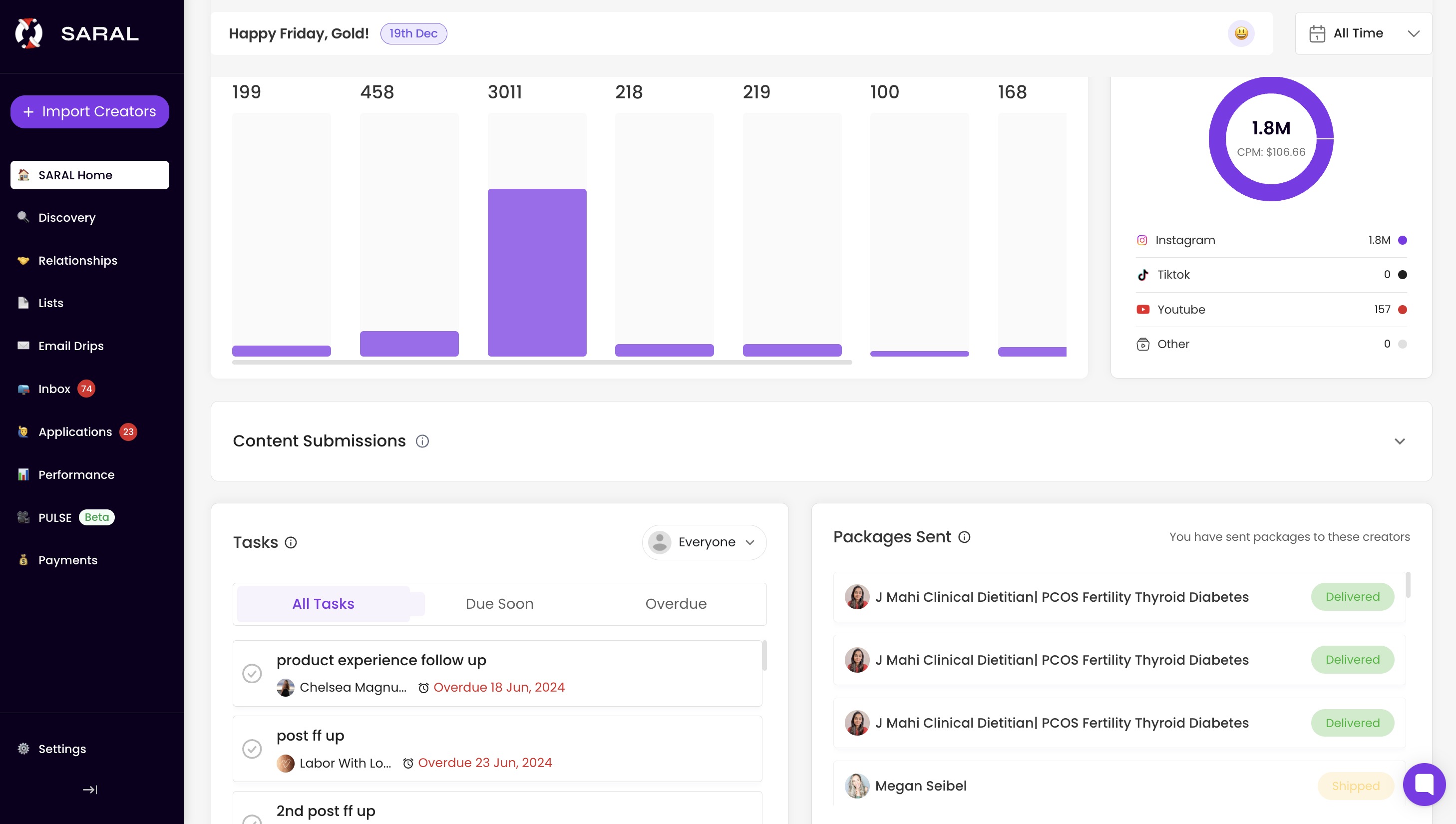
This is why tools exist in the first place. SARAL is built to help teams manage influencer conversations without losing context. Follow-ups, replies, shipping, and next steps all live in one place, so nothing depends on memory or scattered notes.
SARAL does more than outreach. It helps in finding the right influencers, relationship tracking, product shipping, and performance visibility. It’s a system for running the whole influencer program without duct-taping spreadsheets, inboxes, and notes together.
If influencer marketing is already part of your marketing strategy and it’s worth seeing what that looks like with a system designed for it. Book a demo with us here.
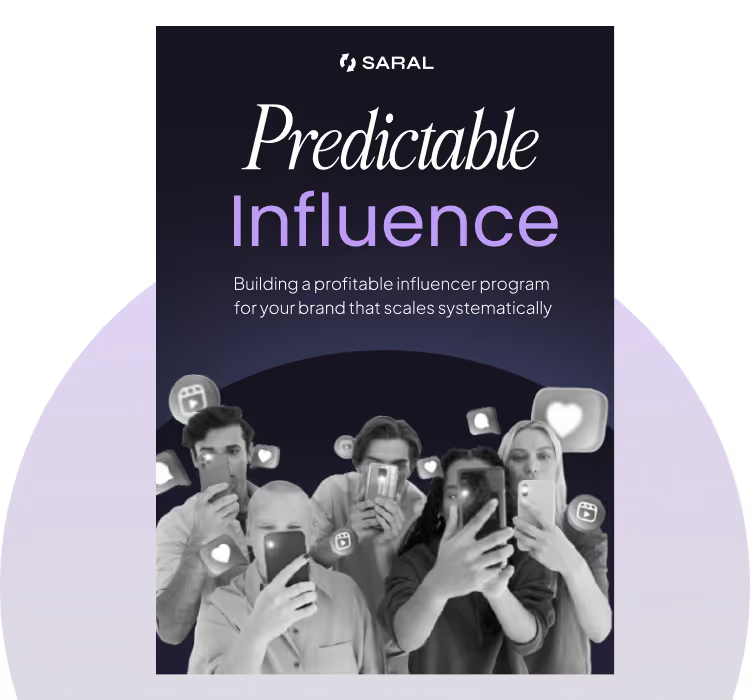
Sign up for a 7-day email course on the unique "Predictable Influence" strategy used by top brands like Grüns, Obvi, Tabs Chocolate.

If ditching the randomness of influencer campaigns and building a predictable, ROI-first influencer program sounds like a plan. Consider talking to our team!
